
Deciding to buy insulation for your home is one of the smartest investments you can make in 2026. Whether you're renovating an older Victorian weatherboard, building an extension, or simply trying to reduce energy bills and improve comfort, the right insulation transforms how your home performs year-round. But with so many types, R-values, materials and applications to consider, knowing where to start can feel overwhelming. This guide walks you through everything you need to know before you buy insulation, helping you choose the right product for your specific needs with confidence.
Understanding Why You Should Buy Insulation Now
Energy costs continue to climb across Victoria, and Melbourne's climate demands homes that perform well in both summer heat and winter cold. When you buy insulation, you're not just purchasing a building material - you're investing in long-term comfort, lower bills, and a more sustainable home.
The benefits extend beyond energy savings. Proper insulation reduces noise transmission between rooms and from outside, creates more consistent indoor temperatures, and can even increase your property's value. According to ENERGY STAR's insulation guidance, homes with adequate insulation can reduce heating and cooling costs by up to 20-30%.
For Melbourne homeowners, where we experience hot summers and cold winters, thermal performance matters in both directions. Quality insulation keeps heat out during January heatwaves and traps warmth inside during June's coldest nights.
The 2026 Landscape for Insulation Buyers
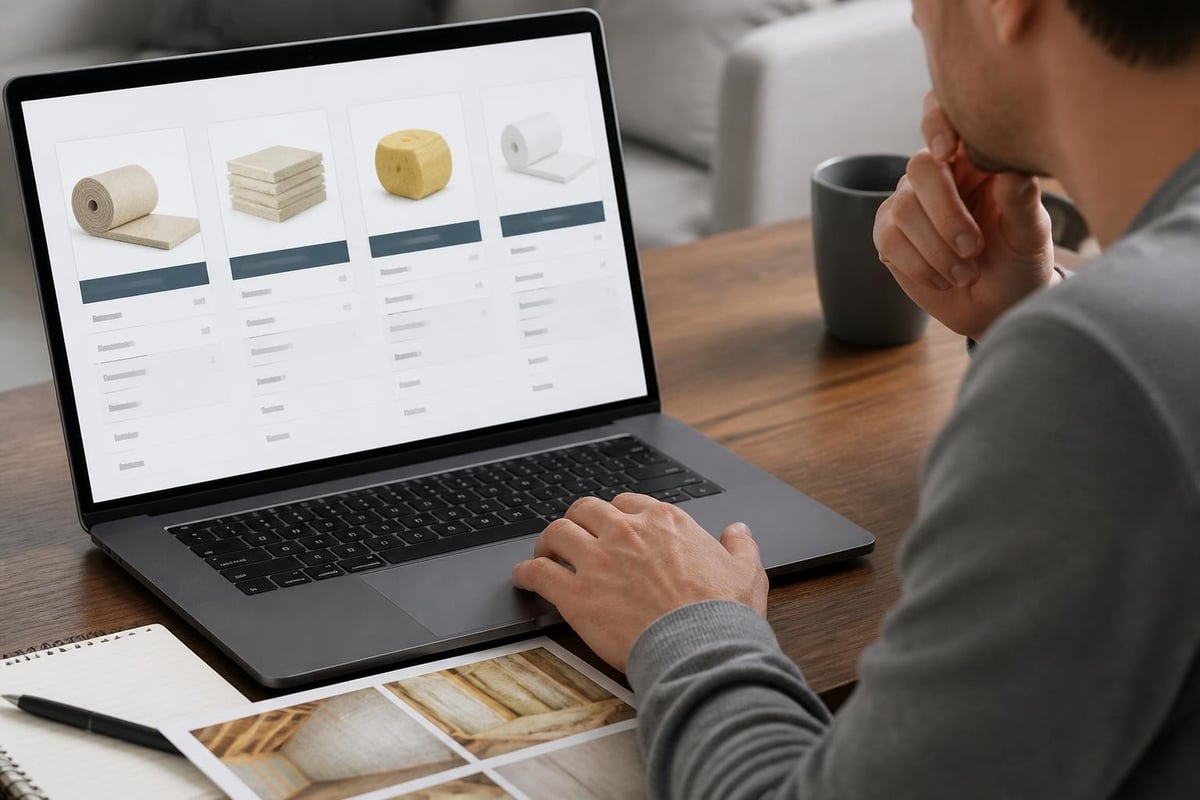
The insulation market in Victoria has evolved significantly. Online suppliers now offer competitive pricing, detailed product information, and convenient delivery options that weren't widely available even five years ago. This makes it easier than ever to buy insulation directly and have it delivered to your project site.
Manufacturing technology has also improved. Modern products like glasswool with ECOSE® Technology offer better handling characteristics, lower dust, and improved environmental credentials compared to older formulations. When you buy insulation today, you're getting access to superior products that are easier to work with and perform better over time.
Types of Insulation You Can Buy
Understanding the different insulation categories helps you match the right product to your specific application. Each type serves different purposes and installation locations.
Thermal Batts and Blankets
Glasswool and polyester batts remain the most popular choice for ceiling and wall insulation across Victoria. These products are cost-effective, widely available, and suitable for most residential applications.
Key advantages when you buy thermal batts:
- Wide range of R-values from R1.5 to R6.0
- Proven performance in Australian conditions
- Easy to handle and install for DIY projects
- Non-combustible fire safety properties
- Excellent thermal resistance per dollar spent
Blanket insulation rolls offer continuous coverage for larger ceiling areas or commercial applications. They're particularly useful when you need to insulate areas without standard stud spacing or want to minimise joints and gaps.
Underfloor Insulation Solutions
Suspended timber floors lose significant heat in winter, making underfloor insulation essential for older Melbourne homes. When you buy insulation specifically designed for underfloor applications, you're addressing both thermal performance and moisture management.
The Sancell Breeze Underfloor 500-3 provides a practical solution that combines insulation with a draught barrier, helping reduce heat loss while blocking cold air movement from beneath the building. This dual function makes it particularly effective for heritage homes with exposed subfloor areas.
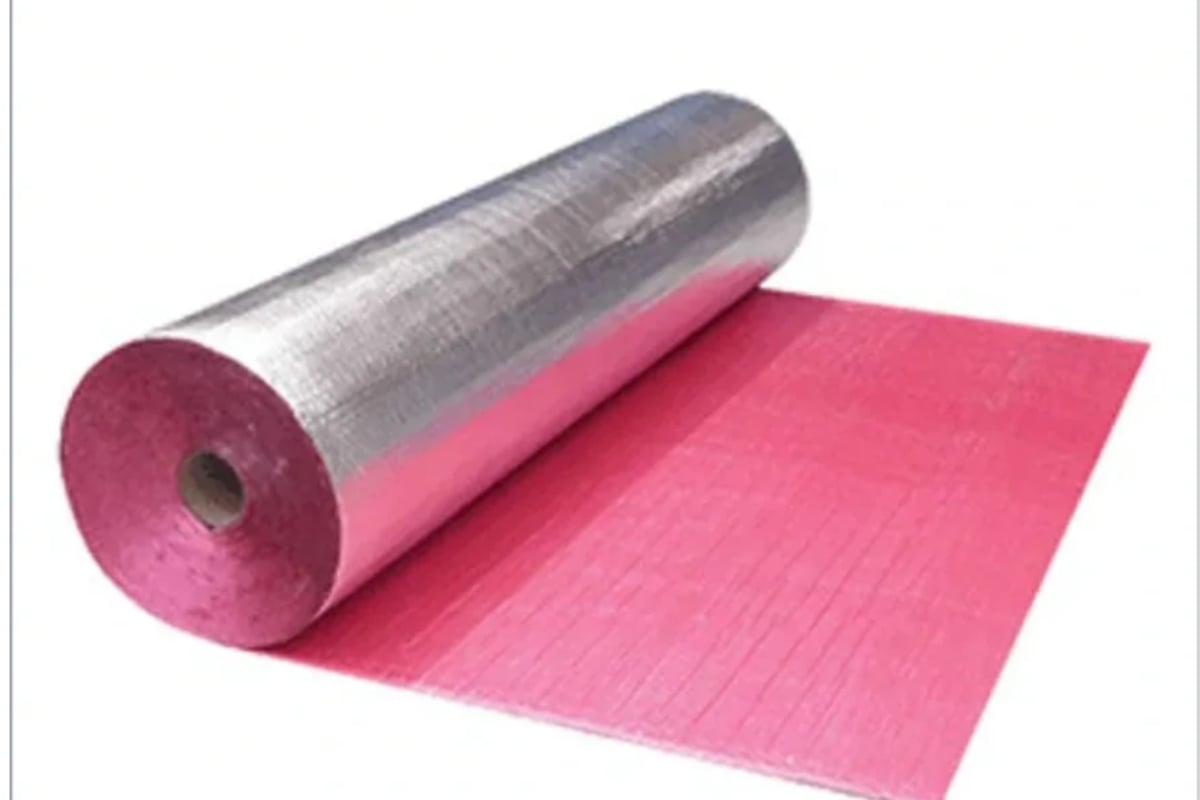
Traditional underfloor batts and reflective foil wraps both have their place depending on your specific floor construction and budget. Consider subfloor clearance, moisture conditions, and whether you're working from above or below when selecting products.
Acoustic Insulation Products
Noise control has become increasingly important as homes accommodate work-from-home offices, media rooms, and multi-generational living arrangements. When you buy insulation with enhanced acoustic properties, you're investing in privacy and comfort.
Higher-density glasswool batts designed for acoustic applications provide superior sound absorption compared to standard thermal batts. They work particularly well in internal walls between bedrooms, home theatres, and music practice rooms.
Rigid Board Insulation
XPS (extruded polystyrene) and EPS (expanded polystyrene) boards offer high compressive strength and moisture resistance, making them ideal for specific applications like underfloor slabs, exterior wall cladding systems, and areas requiring structural load-bearing capacity.
| Insulation Type | Best Application | R-Value Range | Installation Difficulty |
|---|---|---|---|
| Glasswool Batts | Ceilings, walls | R1.5 - R6.0 | Easy (DIY-friendly) |
| Underfloor Batts | Suspended floors | R1.5 - R2.5 | Moderate |
| Acoustic Batts | Internal walls | R2.0 - R2.7 | Easy |
| XPS Board | Slab, exterior | R0.5 - R3.5 | Moderate to difficult |
| Blanket Roll | Large ceiling areas | R1.5 - R4.0 | Moderate |
Determining the Right R-Value Before You Buy Insulation
R-value measures thermal resistance - higher numbers mean better insulation performance. Understanding what R-value you need prevents buying under-specified or over-specified products.
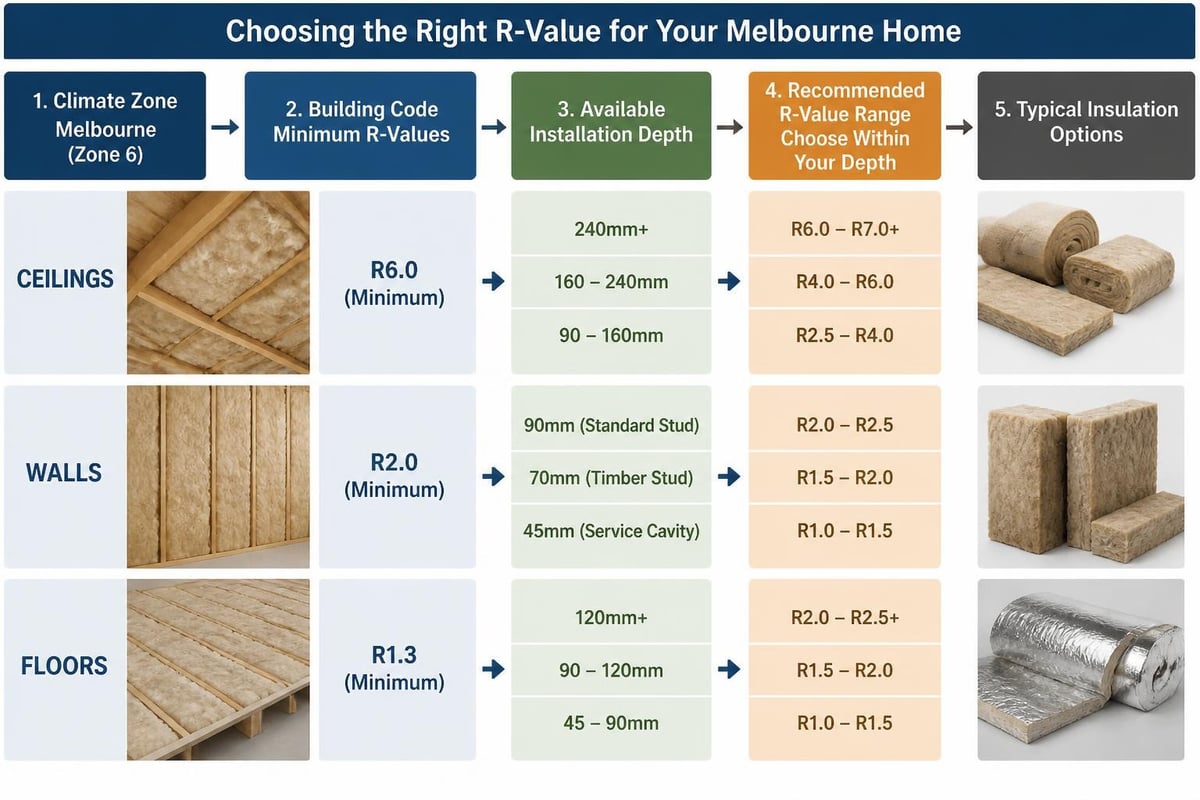
Victoria falls primarily into climate zones 6 and 7 under the National Construction Code. For most Melbourne homes, these are the recommended minimum R-values:
Recommended R-values for Melbourne homes:
- Ceilings: R4.0 to R6.0 minimum
- Walls: R1.5 to R2.5 minimum
- Underfloor: R1.5 to R2.5 minimum
These are minimums. Higher R-values deliver better performance and energy savings, particularly in ceilings where heat loss and gain are most significant. Our guide to climate zones in Australia provides detailed information specific to Victorian conditions.
Balancing R-Value with Available Space
Physical thickness limits what R-value you can achieve in walls and floors. A 90mm stud wall can accommodate approximately R2.5 to R2.7 batts. Ceiling spaces typically allow for R4.0 to R6.0 depending on rafter depth.
When you buy insulation, always verify the product thickness will fit your available cavity depth. Installing compressed batts reduces their R-value and thermal performance.
Calculating How Much Insulation to Buy
Accurate measurement prevents costly shortages or excessive waste. Before you buy insulation, calculate your coverage area carefully.
Measuring for Ceiling Insulation
Measure the total floor area of spaces you're insulating. For a rectangular room, multiply length by width. For complex layouts, break the space into rectangular sections and add them together.
Example calculation:
- Main living area: 6m × 8m = 48m²
- Hallway: 2m × 4m = 8m²
- Bedroom 1: 3.5m × 4m = 14m²
- Total coverage needed: 70m²
Add approximately 5-10% extra to account for cuts, odd spaces, and installation waste. For 70m² actual area, order 75-77m² of insulation coverage.
Measuring for Wall Insulation
Wall insulation requires more careful calculation since you're measuring vertical surface area, not floor area. Measure wall height and length, multiply for each wall section, and subtract window and door openings.
Most wall batts come pre-cut to fit standard stud spacing (430mm, 450mm, or 600mm). Count the number of stud spaces rather than calculating total area - this often provides more accurate quantities.
Underfloor Coverage Calculations
For suspended timber floors, measure the floor area from above. Standard products like underfloor batts install between joists, so check your joist spacing and choose appropriate widths.
Reflective wraps and draught barriers typically come in 500mm widths for standard 450mm joist centres. Calculate your total floor area and match it to product coverage per roll.
Quality Indicators When You Buy Insulation
Not all insulation products deliver the same long-term performance. Look for these quality markers before making your purchase.
Certification and Standards Compliance
Australian-made insulation should comply with AS/NZS 4859 standards. Products carrying CodeMark certification have been independently verified to meet Building Code of Australia requirements.
ECOSE® Technology in Knauf products indicates reduced formaldehyde content and improved handling characteristics compared to conventional glasswool. This matters both for installation comfort and indoor air quality.
Manufacturer Reputation and Support
Established manufacturers like Knauf, Bradford, and CSR Martini stand behind their products with comprehensive technical data, installation guides, and warranties. When you buy insulation from recognised brands, you gain access to proper product support if questions arise during installation.
Lesser-known imported products may offer lower prices but lack local technical support, detailed safety documentation, or proven long-term performance in Australian conditions.
Product-Specific Features
Consider practical features that affect installation and performance:
- Facing materials: Foil facing provides radiant barriers; paper facing eases handling
- Compression packaging: Reduces freight costs but requires expansion time before installation
- Pre-cut sizing: Standard dimensions (430mm, 580mm widths) fit Australian framing
- Density specifications: Higher density generally improves acoustic performance
Where to Buy Insulation: Comparing Your Options
The way you buy insulation affects pricing, convenience, product selection, and support. Each purchasing channel offers different advantages.
Online Insulation Suppliers
Online specialists like Insulation Supplies Australia offer competitive pricing without the overhead of physical retail locations. You can browse detailed product specifications, compare R-values and coverage, and place orders at any time.
Benefits of buying insulation online:
- Lower prices through reduced overhead costs
- Wider product selection across all categories
- Detailed technical specifications and comparison tools
- Convenient delivery scheduling to your project site
- Expert phone and email support for product selection
The main consideration is ensuring you order the correct quantity and product type, since you can't physically inspect items before purchase. Reputable online suppliers provide detailed product descriptions, specifications, and measurements to support confident purchasing decisions.
Trade Suppliers and Building Centres
Traditional building suppliers maintain physical stock and pickup locations. This works well if you need materials immediately or prefer to inspect products in person before purchase.
Pricing tends to be higher than online suppliers due to premises costs, and product selection may be limited to fast-moving lines. Staff knowledge varies considerably between locations.
DIY Retail Chains
Large hardware chains stock consumer-friendly insulation products, often with simplified packaging and smaller quantities suitable for minor projects. Pricing typically sits at the higher end, reflecting retail positioning and customer service costs.
Product selection focuses on popular R-values and standard sizes. Specialty products like high-density acoustic batts or specific underfloor solutions may not be available.
| Purchase Channel | Price Range | Selection | Convenience | Expert Advice |
|---|---|---|---|---|
| Online Specialist | $$ | Excellent | Very High | Strong (phone/email) |
| Trade Supplier | $$$ | Good | Moderate | Variable |
| DIY Retail | $$$$ | Limited | High | Basic |
Installation Considerations Before You Buy Insulation
Understanding installation requirements helps you choose products suited to your skills and project scope. Some insulation types are straightforward for DIY installation; others benefit from professional expertise.
DIY-Friendly Products
Standard ceiling and wall batts designed for residential use are generally accessible to competent DIYers. Products come pre-cut to common stud and joist spacings, making installation straightforward.
Safety equipment matters when you buy insulation for DIY installation. You'll need:
- Disposable dust masks or P2 respirator
- Safety glasses or goggles
- Long sleeves and gloves
- Good lighting for ceiling spaces
The ENERGY STAR DIY insulation guide provides practical step-by-step instructions for common residential applications.
When to Consider Professional Installation
Complex projects benefit from professional installers who work efficiently, ensure proper coverage, and manage safety considerations. Consider professional installation for:
- Full-home retrofits requiring removal of existing insulation
- Hard-to-access ceiling spaces with limited clearance
- Cavity wall insulation requiring pumping equipment
- Projects requiring building permits or inspections
Professional installation costs vary but typically add $10-25 per square metre depending on application complexity and accessibility.
Compliance and Safety Requirements
Some insulation work requires permits, particularly if you're altering building structure or working near electrical wiring. Check with your local council before starting major insulation projects.
Maintain clearances around recessed downlights, exhaust fans, and other heat-producing fixtures. Use appropriate products rated for proximity to these items or install protective shields. Our guide to ceiling insulation in Melbourne covers these considerations in detail.
Timing Your Insulation Purchase
Strategic timing when you buy insulation can affect pricing, availability, and project scheduling.
Seasonal Considerations
Demand for ceiling insulation peaks before summer (October-December) as homeowners prepare for heat protection, and before winter (April-June) for thermal retention. Buying during shoulder seasons (February-March, August-September) can occasionally yield better pricing and guaranteed stock availability.
Installation is actually easier during mild weather when working in roof spaces is more comfortable. Extreme heat makes ceiling work dangerous; cold conditions make handling batts less pleasant.
Project Planning and Lead Times
Order insulation with enough lead time to accommodate delivery schedules and any product sourcing requirements. Standard products typically ship within 2-5 business days across Victoria. Specialty items or bulk orders may require longer timeframes.
Coordinate insulation delivery with your project timeline. Having materials sit on site for extended periods risks weather damage, theft, or compression from stacked storage.
Bulk Purchasing Advantages
If you're insulating an entire home or managing multiple properties, buying insulation in larger quantities often secures better per-square-metre pricing. Many suppliers offer volume discounts on full pallet or multiple-pack orders.
Calculate your total project requirements across all areas - ceiling, walls, and underfloor - to maximise bulk buying benefits while ensuring you need the quantities ordered.
Cost Considerations When You Buy Insulation
Understanding pricing structures helps you budget accurately and identify genuine value versus false economy.
Per-Square-Metre vs Pack Pricing
Insulation is sold either by individual packs with specified coverage or by the square metre for bulk orders. Always calculate and compare the per-square-metre cost to ensure you're comparing like with like.
Example pricing comparison (typical 2026 Victoria):
- R4.0 ceiling batts: $7-12 per m² (varies by brand and density)
- R2.5 wall batts: $6-10 per m²
- R2.5 underfloor batts: $9-14 per m²
- Acoustic high-density batts: $12-18 per m²
Prices vary based on R-value, density, facing materials, and brand reputation. Higher prices don't always mean better performance - compare specifications carefully.
Total Project Cost Estimation
Beyond product costs, factor in:
- Delivery charges: Often free over minimum order values ($200-300 typical threshold)
- Installation supplies: Tape, fixings, safety equipment
- Installation labour: If hiring professionals ($10-25 per m² typical)
- Disposal costs: Removing old insulation if required
A typical 150m² ceiling insulation project using R4.0 batts might cost:
- Materials: 150m² × $9/m² = $1,350
- Delivery: $0 (free over $200)
- Installation supplies: $80
- DIY installation: $0 (or professional: $2,250)
- Total DIY: ~$1,430 | Total professional: ~$3,680
Value vs Price
The cheapest insulation isn't always the best value. Consider:
- Long-term performance and durability
- Ease of installation reducing labour time
- Better R-value delivering ongoing energy savings
- Quality manufacturing reducing irritation and handling issues
Products meeting Australian standards from reputable manufacturers generally deliver better long-term value than unknown imported alternatives, even if initial pricing is slightly higher.
Common Mistakes to Avoid When You Buy Insulation
Learning from others' experiences helps you avoid costly errors when purchasing insulation products.
Under-Specifying R-Value
Choosing the minimum code-compliant R-value might save money initially but costs more in ongoing energy bills and reduced comfort. For Melbourne ceilings, R4.0 should be considered a starting point, not a target. R5.0 or R6.0 delivers measurably better performance.
Incorrect Product for Application
Wall batts won't perform well as underfloor insulation due to compression and moisture issues. Ceiling batts installed in walls may not fit properly or deliver expected acoustic performance. Always buy insulation specifically designed for your intended application.
The Building Science Corporation resources provide detailed guidance on matching products to assemblies and avoiding common specification errors.
Inadequate Quantity Calculations
Running short mid-project creates delays and additional delivery costs. Ordering excessive quantities wastes money and creates disposal problems. Measure carefully, add reasonable allowances for waste, and round up to complete packs rather than ordering exact calculated quantities.
Ignoring Installation Clearances
Buying insulation without checking available cavity depth leads to compression or inability to install. Verify your stud, joist, or rafter depths before selecting products. Standard wall studs (90mm) accommodate R2.5 batts; deeper studs may allow higher R-values.
Overlooking Complementary Products
Insulation performs best as part of a complete building envelope system. Don't forget to buy insulation accessories like:
- Building wrap or sarking for weather protection
- Tape for sealing joins and penetrations
- Fixing materials appropriate to your installation method
- Safety equipment for proper installation
Our guide to build wrap explains how these products work together with insulation.
Making Your Final Decision
With your research complete, follow this systematic approach when you're ready to buy insulation.
Step 1: Confirm Your Specifications
Write down exactly what you need:
- Application areas (ceiling, wall, underfloor)
- Required R-values for each area
- Total coverage in square metres
- Product preferences (glasswool, polyester, rigid board)
Step 2: Compare Products and Prices
Review 2-3 suppliers offering products meeting your specifications. Compare:
- Per-square-metre pricing
- Delivery costs and timeframes
- Product technical specifications
- Manufacturer reputation and warranty
- Customer reviews and support quality
Step 3: Verify Compatibility
Double-check that selected products:
- Fit your available cavity depths
- Match your stud/joist spacing
- Meet or exceed code requirements
- Suit your installation method (DIY or professional)
Step 4: Calculate Final Quantities
Add your waste allowance (5-10%) to measured areas. Round up to complete packs. Verify your calculations one final time before ordering.
Step 5: Place Your Order
Provide accurate delivery information including:
- Site access considerations
- Preferred delivery date and time window
- Contact details for delivery coordination
- Any special handling requirements
When you buy insulation through a professional online supplier, they'll confirm your order details and provide tracking information for your shipment.
Making the right decision when you buy insulation sets the foundation for a comfortable, energy-efficient home that performs well for decades. By understanding your specific requirements, comparing products systematically, and choosing appropriate R-values and materials for each application, you'll maximise both immediate comfort and long-term value. Insulation Supplies Australia makes it simple to research, compare, and purchase the right insulation products for your Melbourne home or project, with expert advice, competitive pricing, and fast delivery across Victoria. Browse our full range today and take the next step toward a better-performing home.