
Noisy neighbours, loud televisions in the next room, and traffic sounds bleeding through external walls are common frustrations in Australian homes. Whether you're building new, renovating, or just trying to create a quieter home, understanding how wall insulation sound performance works is essential. The right insulation choices can transform a noisy house into a peaceful sanctuary, but the wrong approach wastes money and delivers disappointing results. This guide explains everything you need to know about acoustic insulation, how different materials perform, and what actually works in real-world Australian conditions.
How Wall Insulation Sound Performance Actually Works
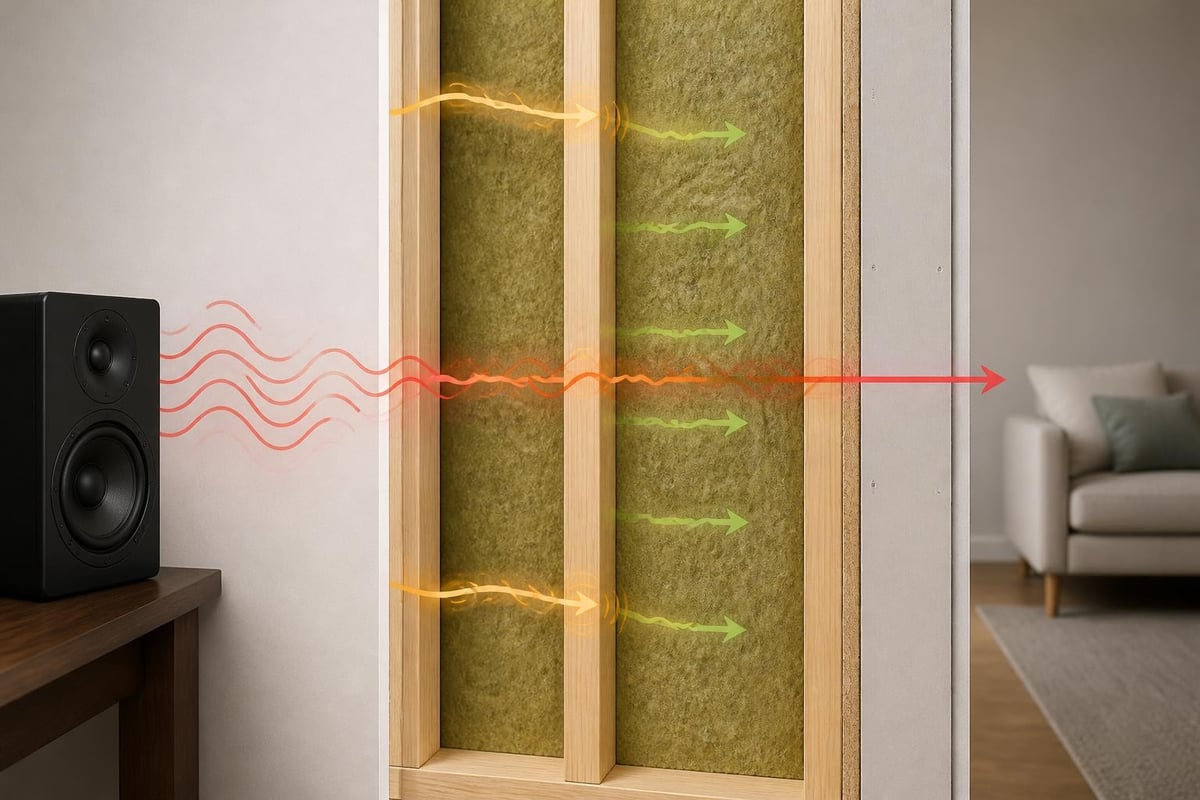
Sound travels through walls in two main ways: direct transmission through the materials themselves and indirect transmission through structural connections, air gaps, and penetrations. Wall insulation sound control relies on interrupting these pathways.
When sound waves hit a wall, they cause the material to vibrate. These vibrations transfer energy through the wall structure and re-radiate as sound on the other side. Dense, heavy materials naturally resist this vibration better than light ones. That's why a double-brick wall performs better acoustically than a lightweight timber frame, even before you add insulation.
Insulation improves acoustic performance by:
- Adding mass to the wall cavity
- Damping vibrations within the frame
- Absorbing sound energy as it tries to pass through
- Reducing resonance within the cavity space
The key principle is that sound energy gets converted to tiny amounts of heat as it moves through the fibrous insulation material. Higher-density insulation batts contain more material in the same space, creating more friction and absorbing more sound energy.
Understanding STC Ratings and What They Mean
The Sound Transmission Class (STC) rating is the standard measure of how well a wall assembly blocks airborne sound. A higher STC number means better sound blocking. The rating comes from laboratory testing under controlled conditions following procedures like those detailed in BS EN ISO 140 series standards.
Here's what different STC ratings mean in practice:
| STC Rating | Performance Level | What You'll Hear |
|---|---|---|
| STC 25-30 | Poor | Normal speech clearly understood |
| STC 30-35 | Fair | Loud speech understood, normal speech heard |
| STC 35-40 | Good | Loud speech heard but not understood |
| STC 40-45 | Very Good | Loud speech faintly heard |
| STC 45-50 | Excellent | Loud speech barely audible |
| STC 50+ | Superior | Exceptional privacy and quiet |
Most standard timber-framed walls with standard insulation achieve STC 35-42. Adding high-density acoustic insulation can push this to STC 42-48. For reference, the Scottish Building Standards Technical Handbook provides detailed regulatory guidance on separating wall performance requirements, which Australian builders often reference.
It's important to understand that STC ratings measure the complete wall assembly, not just the insulation. The same insulation batt will perform differently depending on wall framing, plasterboard thickness, air gaps, and installation quality.
Material Types and Their Acoustic Performance
Different insulation materials offer varying levels of wall insulation sound control. The material type, density, and thickness all influence acoustic performance.
Glasswool Acoustic Insulation
Glasswool is the most common choice for acoustic applications in Australian walls. Higher-density glasswool batts (typically 20-24 kg/m³) significantly outperform standard thermal batts (11-14 kg/m³) for sound blocking.
Advantages of glasswool for acoustics:
- Excellent sound absorption across speech frequencies
- Available in acoustic-specific high-density variants
- Non-combustible and safe for wall cavities
- Cost-effective for most residential projects
- Easy to cut and fit around services
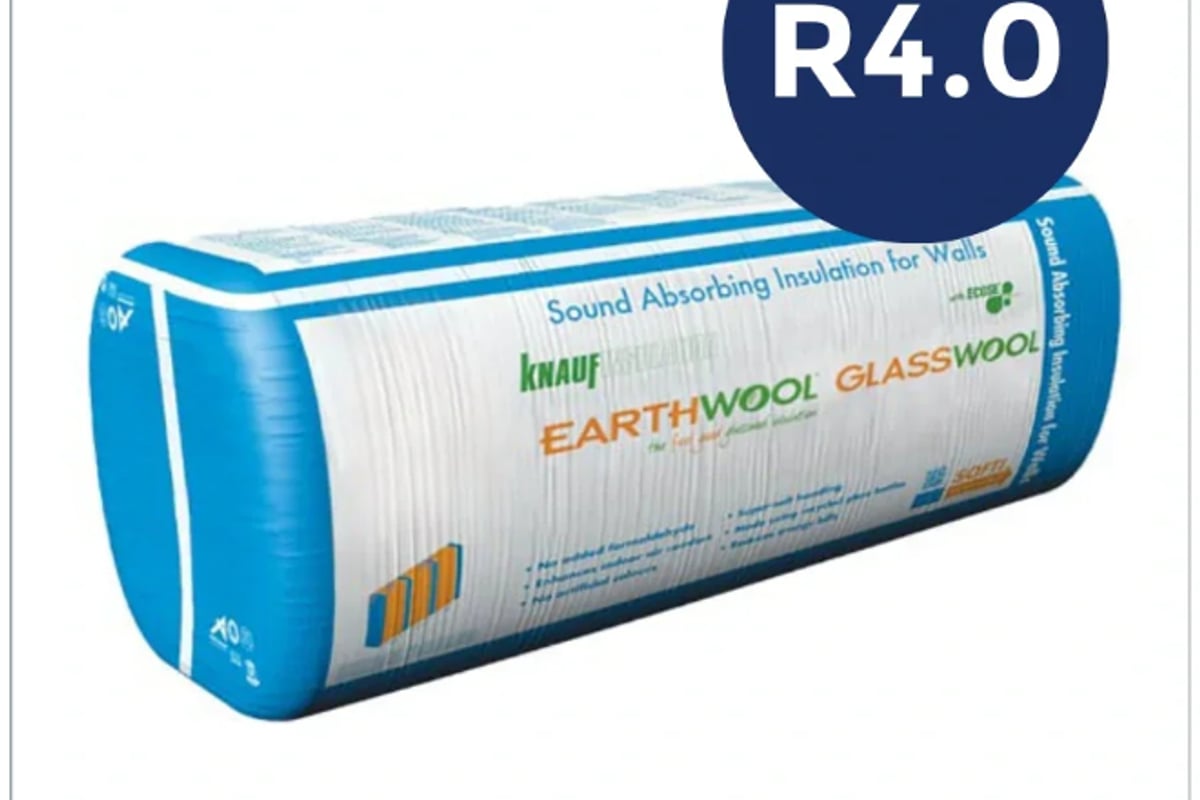
The Earthwool Sound Shield R4.0 140x580mm 22.6kg/m³ represents a premium acoustic option, with higher density specifically engineered for superior noise reduction in walls where both thermal and acoustic performance matter.
Polyester Acoustic Batts
Polyester insulation offers a dust-free, itch-free alternative to glasswool. While generally less dense than acoustic glasswool options, quality polyester batts still deliver good sound absorption.
These batts work well in bedrooms, home offices, and media rooms where handling comfort matters. They're particularly popular with DIY renovators and owner-builders who want easier installation without protective gear.
Rock Wool for Maximum Acoustic Performance
Rock wool (also called stone wool) is the premium choice when maximum wall insulation sound control is essential. With densities often reaching 45-60 kg/m³, rock wool outperforms glasswool and polyester in acoustic testing.
The downside is cost and availability. Rock wool typically costs 40-60% more than equivalent glasswool acoustic batts. For most Australian residential applications, high-density glasswool provides the best balance of performance and value.
Wall Construction Methods and Acoustic Design
The wall structure itself has as much impact on sound transmission as the insulation choice. Even the best acoustic insulation won't deliver good results in a poorly designed wall assembly.
Standard Timber Frame Walls
A typical 90mm timber-framed wall with 13mm plasterboard on both sides provides limited acoustic separation even with standard insulation. The studs create a direct sound path, vibrations transfer easily through the timber frame, and the lightweight construction offers minimal mass.
Improvements for standard frame walls:
- Use high-density acoustic insulation instead of standard thermal batts
- Upgrade to 16mm plasterboard or double layers of 13mm
- Ensure insulation fills the entire cavity with no gaps
- Seal all penetrations and gaps around services
- Use acoustic sealant at floor and ceiling junctions
Staggered Stud and Double Stud Walls
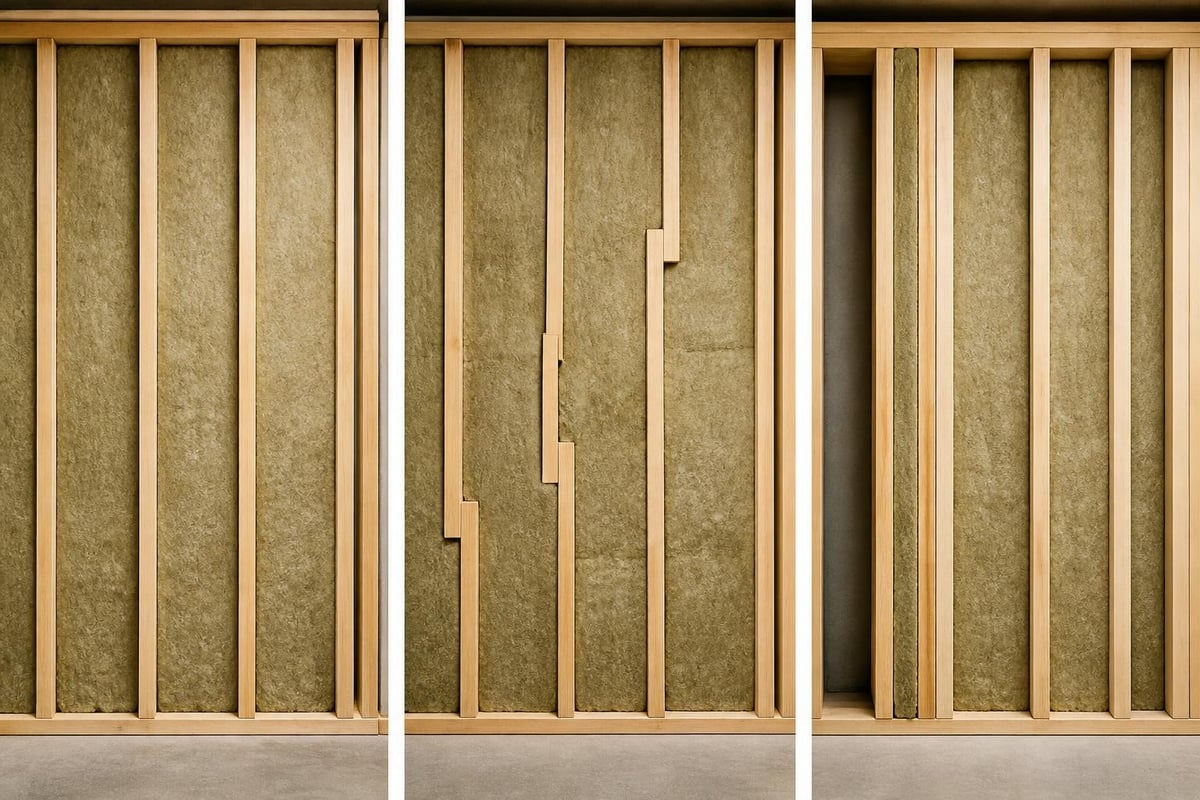
For serious acoustic separation, staggered stud or double stud walls break the direct vibration path. In a staggered design, studs on each side of the wall are offset, so the plasterboard on one side doesn't share framing with the other side.
This configuration costs more in materials and reduces floor space slightly, but delivers STC ratings of 50-55 when combined with proper acoustic insulation. It's ideal for party walls in duplexes, home theatres, music rooms, or bedrooms adjacent to noisy living areas.
Resilient Mounting Systems
Resilient channels and acoustic clips physically isolate the plasterboard from the timber frame, dramatically reducing vibration transfer. These systems add 10-15mm to wall thickness but can improve STC ratings by 5-10 points.
The channels or clips attach to the studs, then the plasterboard screws to the resilient mounting system rather than directly to the timber. This isolation prevents sound vibrations in the plasterboard from transferring directly into the structural frame.
For best results, combine resilient mounting with high-density wall insulation sound batts and heavier plasterboard. This three-part approach tackles mass, decoupling, and absorption simultaneously.
Installation Best Practices for Maximum Performance
Perfect installation matters more for acoustic performance than thermal performance. Small gaps, compressions, or installation errors can significantly degrade wall insulation sound control.
Cavity Filling and Avoiding Gaps
The insulation must completely fill the wall cavity from top to bottom and side to side. Even a 5% gap in coverage can reduce acoustic performance by 15-20%. Sound finds the path of least resistance, and an unfilled cavity section becomes an acoustic weak point.
Key installation steps:
- Measure each cavity carefully before cutting batts
- Cut batts 2-3mm oversized for a friction fit
- Ensure batts sit tightly against the plasterboard (no air gap)
- Fill irregular cavities around windows and doors
- Cut around electrical boxes rather than compressing insulation
Research from the Acoustical Society analysing penetrations in drywall constructions confirms that service penetrations and gaps are among the most significant factors degrading real-world acoustic performance compared to laboratory ratings.
Handling Services and Penetrations
Electrical outlets, light switches, and ducting create acoustic weak points. Where possible, offset electrical boxes on opposite sides of the wall so they don't align. Use acoustic putty pads behind boxes and seal cable penetrations.
For shared walls between rooms, consider running services through ceiling spaces or within one room only, avoiding penetrations through the acoustic barrier entirely.
Addressing Flanking Paths
Sound doesn't only travel directly through walls; it also flanks around them via floor structures, ceiling spaces, and adjacent walls. A perfectly insulated and constructed wall will underperform if sound simply travels through the floor cavity or over the top through a shared ceiling space.
Addressing flanking paths:
- Extend wall insulation into ceiling spaces above partition walls
- Use acoustic underlay in floor systems
- Seal gaps at wall junctions with acoustic sealant
- Consider acoustic performance of the entire room envelope
Comparing Thermal vs Acoustic Insulation Specifications
Standard thermal insulation and acoustic insulation look similar but have different priorities. Understanding these differences helps you choose the right product for each application.
| Feature | Thermal Insulation | Acoustic Insulation |
|---|---|---|
| Primary Goal | Resist heat flow (R-value) | Absorb and block sound (density/NRC) |
| Typical Density | 11-14 kg/m³ | 20-24 kg/m³ (or higher) |
| Thickness Priority | Thicker = better (for R-value) | Density more important than thickness |
| Cost | Lower | 30-60% premium |
| Best Application | Roof, ceiling, external walls | Internal walls, party walls |
You can use thermal insulation in walls and it will provide some acoustic benefit, but you won't achieve the same sound blocking as purpose-designed acoustic products. The wall insulation collection offers options suitable for both thermal and acoustic applications.
For external walls, prioritise thermal performance and accept the moderate acoustic benefit as a secondary gain. For internal walls where noise control matters, choose high-density acoustic-specific products.
Room-Specific Considerations and Applications
Different rooms have different acoustic priorities, and wall insulation sound strategies should reflect actual usage patterns.
Bedrooms and Living Areas
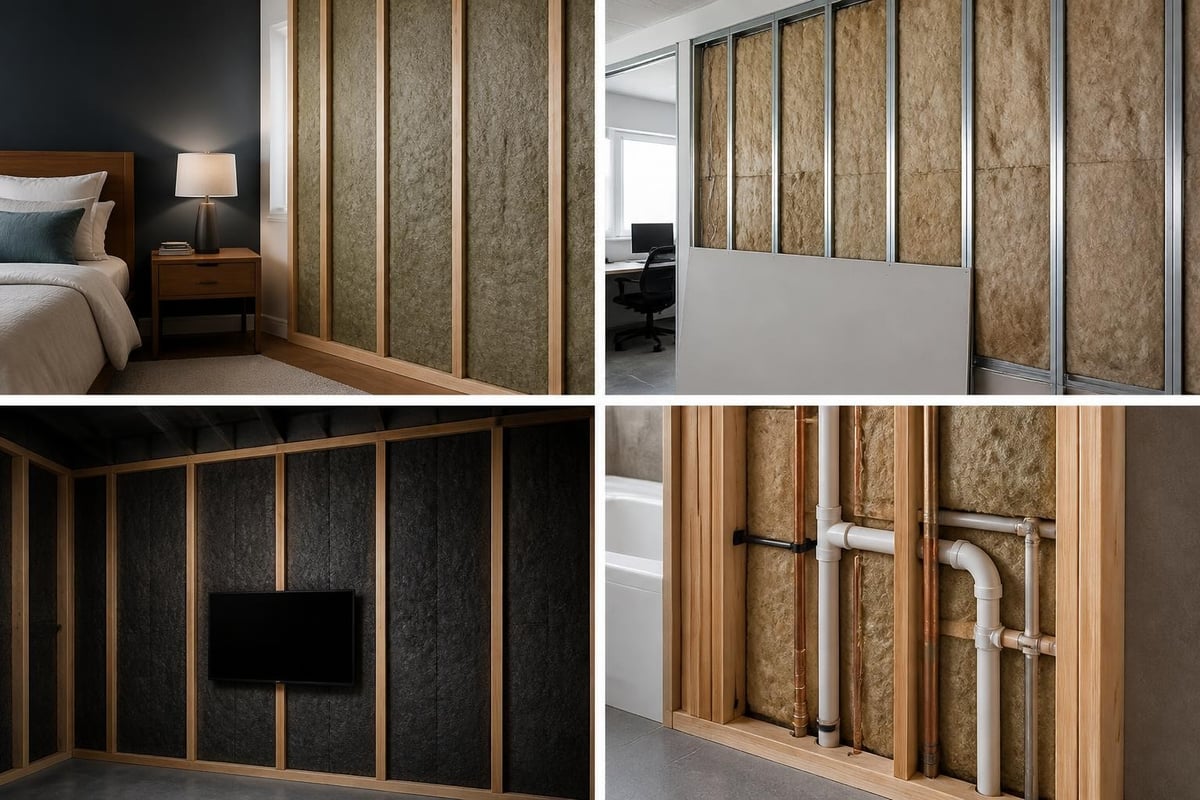
Bedrooms benefit most from acoustic insulation in walls shared with living areas, bathrooms, and other bedrooms. The wall between a bedroom and a hallway or wardrobe is less critical acoustically.
In open-plan homes, consider partial acoustic walls to define spaces without completely closing them off. A wall that reaches only partway to the ceiling won't deliver full acoustic separation, but it's better than nothing.
Home Offices and Study Spaces
With more Australians working from home in 2026, home office acoustic privacy has become essential. Video calls require speech clarity without background noise bleeding through.
High-density glasswool in office walls reduces distracting household sounds during work hours. Combined with a solid-core door and good sealing, it creates a professional working environment even in a busy household.
Media Rooms and Home Theatres
Home theatres require two-way acoustic control: keeping sound in (so the family can sleep) and keeping sound out (for immersive viewing). This demands the highest-performing wall assemblies.
Media room acoustic walls typically include:
- Double-layer plasterboard (2 x 13mm or 16mm + 13mm)
- High-density acoustic insulation (minimum 22 kg/m³)
- Resilient mounting or staggered studs
- Acoustic sealant at all junctions
- Minimal penetrations through walls
The acoustic insulation collection provides specialised options for these demanding applications where both impact sound and airborne sound control matter.
Bathrooms and Laundries
These wet areas generate significant noise from plumbing, appliances, and hard reflective surfaces. Insulating walls around bathrooms improves privacy and reduces noise transmission to adjacent bedrooms or living areas.
Pay particular attention to sealing around pipes and ensuring insulation doesn't get wet during construction. Use acoustic batts that maintain performance in occasional moisture exposure.
Impact Sound vs Airborne Sound
Wall insulation sound performance focuses primarily on airborne sound (voices, TV, music), but understanding impact sound helps with whole-house acoustic planning.
Airborne sound travels through the air and causes walls to vibrate. This is what insulation addresses most directly. Impact sound comes from physical vibrations like footsteps, dropped objects, or furniture moving. These vibrations transfer through the structure itself.
While wall insulation helps with airborne sound transmission between rooms, impact sound requires different strategies like carpet, acoustic underlay, resilient floor systems, and structural isolation. When planning acoustic improvements, consider both sound types for the best overall result.
Common Mistakes That Reduce Acoustic Performance
Even with quality materials, poor execution undermines wall insulation sound control. These mistakes occur frequently in renovations and owner-builder projects.
Compression and over-stuffing: Compressing insulation into a cavity reduces acoustic performance. The air space within the material matters for sound absorption. If a 90mm batt is compressed into a 70mm cavity, it won't perform as well as a 70mm batt designed for that depth.
Gaps and incomplete coverage: As mentioned earlier, gaps severely impact performance. This includes gaps at top and bottom plates, around services, and at wall junctions.
Wrong product for the application: Using standard R2.5 thermal batts in a shared wall won't deliver the acoustic performance of proper high-density acoustic insulation, even if they're both 90mm thick.
Ignoring the wall assembly: Focusing only on insulation while ignoring plasterboard choice, framing methods, and sealing wastes money. The assembly matters more than any single component.
Unrealistic expectations: Even excellent acoustic insulation won't make walls completely soundproof. Halving perceived noise requires roughly 10 points of STC improvement. Achieving STC 50+ requires significant investment in complete wall assembly design.
Testing and Verification Methods
Professional acoustic testing can verify wall performance, though it's expensive for residential applications. For most homeowners, understanding the principles and following proven methods delivers reliable results without formal testing.
Laboratory testing per standards like DIN EN ISO 10140 using finite-element modelling provides precise STC ratings but requires specialised facilities. Field testing in occupied buildings is less precise but measures real-world performance including flanking paths and installation quality.
For DIY verification, simple observation works surprisingly well. Stand on each side of a completed wall and test conversation volume, TV audio, and music. This won't give you an STC number, but you'll quickly understand whether the wall meets your acoustic needs.
Cost Considerations and Value Analysis
Acoustic wall construction costs more than standard thermal walls, but the premium varies widely based on your approach.
Upgrading from standard 11 kg/m³ glasswool to 22 kg/m³ acoustic batts adds roughly 30-50% to insulation material cost but only 8-15% to total wall cost when you include framing and plasterboard. This is the most cost-effective single upgrade.
Adding double plasterboard or upgrading to 16mm costs significantly more but delivers measurable improvements. Resilient mounting systems add both material cost and labour complexity.
Budget-conscious acoustic wall approach:
- Standard timber framing (90mm or 140mm)
- High-density acoustic insulation batts
- Single layer 16mm plasterboard (or 2 x 13mm)
- Acoustic sealant at junctions
- Careful attention to complete cavity filling
This approach typically costs 25-40% more than a basic wall but delivers 8-12 points of STC improvement. For most residential applications, it hits the sweet spot of performance and investment.
Product Selection Criteria for Australian Conditions
When choosing wall insulation sound products for your project, several factors beyond just density and STC ratings deserve consideration.
Climate compatibility: Melbourne and Victoria experience significant temperature swings. Products performing well thermally as well as acoustically deliver year-round value. An R4.0 acoustic batt provides better thermal performance than an R2.0, even if acoustic performance is similar.
Installation considerations: Some materials are easier to cut, fit, and handle than others. If you're doing the work yourself, handling characteristics matter. High-density glasswool can be more challenging to cut precisely than polyester, though it generally performs better acoustically.
Moisture resistance: In cavity walls, occasional moisture exposure can occur during construction or from plumbing leaks. Most glasswool acoustic batts tolerate temporary dampness well if they can dry out, but verify product specifications.
Availability and lead times: Not all acoustic products are readily available across Victoria. Check stock and delivery times, particularly for specialty high-density products. The Knauf insulation collection offers reliable availability for popular acoustic applications.
Multi-Residential and Duplex Considerations
Party walls between separate dwellings require higher acoustic performance than walls within a single home. Regulatory requirements often mandate minimum STC ratings of 45-50 for separating walls.
Achieving this performance demands careful design:
- Minimum double-stud or staggered-stud framing
- High-density acoustic insulation filling entire cavity
- Double-layer plasterboard both sides (often with one layer being 16mm)
- Acoustic sealant at all junctions
- Resilient mounting on at least one side
- No shared electrical boxes or ducting penetrations
For builders and renovators working on duplexes or townhouses, consult local building codes early in design. Remedial acoustic work after construction is expensive and disruptive, making it essential to get party wall construction right the first time.
Integration with Other Building Systems
Wall insulation sound performance doesn't exist in isolation. It integrates with electrical, plumbing, HVAC, and other building systems.
Electrical planning: Route wiring to minimise wall penetrations where acoustic performance matters. Consider surface-mounted conduit or ceiling-routed cables for critical walls. When outlets are necessary, use acoustic boxes and putty pads.
HVAC and ducting: Hard ducting transmits sound very effectively. Avoid running ducts through high-performance acoustic walls. If unavoidable, use flexible ducting with internal acoustic lining and install in-line silencers.
Plumbing: Water hammer and drain noise travel through pipes and into walls. Acoustic isolation of pipes, proper mounting, and insulation around pipe penetrations all contribute to overall acoustic performance.
Early coordination between trades prevents acoustic compromises later. If your electrician doesn't know which walls are acoustic priorities, they might locate services in ways that undermine your wall insulation sound strategy.
Effective wall insulation sound control combines smart material choices, proper construction methods, and attention to detail during installation. Understanding STC ratings, density requirements, and the complete wall assembly helps you make informed decisions that deliver real acoustic improvement. Whether you're building new, renovating, or upgrading specific walls, Insulation Supplies Australia offers acoustic insulation products suitable for residential and commercial applications across Victoria, with expert guidance to help you select the right solution for your specific needs.