

Noise pollution impacts everyday comfort in Australian homes more than most people realise. Whether it's traffic from nearby roads, noisy neighbours, or sound travelling between bedrooms and living areas, unwanted noise disrupts sleep, concentration, and quality of life. A properly designed sound insulation wall offers a practical solution, reducing noise transmission and creating quieter, more comfortable living spaces. Understanding how acoustic insulation works and choosing the right materials makes all the difference between a minor improvement and truly effective noise reduction.
Understanding How a Sound Insulation Wall Works
Sound travels through walls in two main ways: through the air and through the structure itself. Airborne sound includes voices, television noise, and music, while impact sound comes from footsteps, furniture movement, or vibrations. A sound insulation wall addresses both types by combining mass, absorption, and isolation techniques.
Mass makes it harder for sound waves to vibrate the wall. Heavier materials like double layers of plasterboard naturally block more noise than lightweight single-layer walls. Absorption involves materials that trap sound energy within their fibrous structure, preventing it from passing through. Isolation uses air gaps and resilient connections to break the path sound travels, stopping vibrations from moving easily from one side to another.
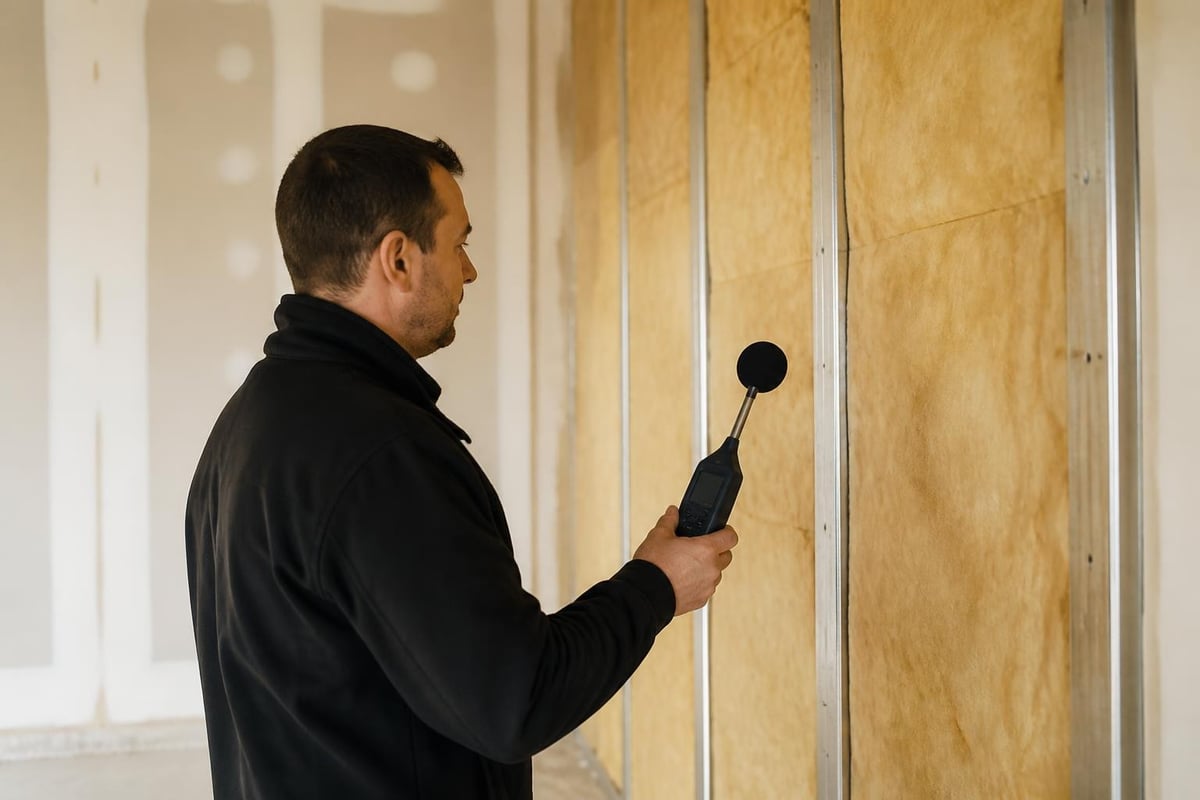
The effectiveness of a sound insulation wall is measured using the Sound Transmission Class (STC) rating. Higher STC values indicate better sound blocking performance. A standard single-stud wall with no insulation typically rates around STC 33, while a well-designed acoustic wall can achieve STC 50 or higher. The difference is dramatic in real-world terms.
Key Components of Effective Acoustic Wall Design
Building a sound insulation wall requires attention to several critical components working together. The wall frame itself plays a fundamental role. Staggered-stud construction or double-stud walls with separate frames for each side prevent direct vibration transfer between wall surfaces. This breaks the sound transmission path more effectively than single-stud designs.
Cavity insulation fills the space between wall linings with acoustic batts made from glasswool or rockwool. These materials absorb sound energy as it passes through the wall cavity. The Earthwool Sound Shield R4.0 offers premium acoustic performance with high-density construction specifically engineered for noise reduction in walls where superior sound control is essential.
Wall linings contribute mass and additional sound blocking. Multiple layers of plasterboard increase mass without excessive thickness. Some builders add specialised acoustic plasterboard for enhanced performance. Sealing every gap, crack, and penetration ensures sound can't leak through weak points that undermine the entire system.
Choosing the Right Materials for Your Sound Insulation Wall
Material selection determines how well your sound insulation wall performs. Not all insulation products are created equal when it comes to acoustic control. Density, thickness, and material composition all influence sound absorption capabilities.
Glasswool acoustic batts offer excellent sound absorption across a wide frequency range. Higher density products perform better for noise control. Products rated between 18 kg/m³ and 27 kg/m³ deliver superior acoustic results compared to standard thermal insulation batts.
Rockwool insulation provides slightly better acoustic performance in some applications due to its higher density and different fibre structure. Both glasswool and rockwool work effectively when properly installed.
Reflective foil insulation primarily serves thermal purposes and provides minimal acoustic benefit. While it has a place in building construction, it's not suitable as the primary acoustic layer in a sound insulation wall.
| Material Type | Typical Density | Best Application | Acoustic Rating |
|---|---|---|---|
| Standard glasswool batt | 11-14 kg/m³ | Basic thermal insulation | Moderate |
| Acoustic glasswool batt | 18-22 kg/m³ | Internal walls, bedrooms | Good |
| High-density acoustic batt | 22-27 kg/m³ | Party walls, studios | Excellent |
| Rockwool slab | 40-60 kg/m³ | Commercial, high-performance | Excellent |
The National Research Council Canada research demonstrates how different wall constructions and materials affect sound transmission control, providing valuable technical insights for builders and renovators.
Matching Insulation to Your Noise Problem
Different noise problems require different solutions. Understanding your specific situation helps you choose the most appropriate sound insulation wall design and materials.
Street traffic noise typically involves low to mid-frequency sounds. These require mass and absorption combined. A double-layer plasterboard system with high-density acoustic batts in a standard stud wall provides good results. Staggered-stud construction offers even better performance.
Neighbouring property noise through party walls demands the highest performance levels. Double-stud walls with separate frames, high-density insulation, and multiple plasterboard layers achieve STC ratings above 55. Some situations benefit from additional resilient channels that further decouple wall surfaces.
Internal room-to-room noise involves moderate sound levels like television, conversation, or music. Standard stud walls with acoustic batts and double plasterboard typically suffice. Focus on sealing door frames, electrical outlets, and service penetrations where sound leaks commonly occur.
Research from NIST on sound insulation properties provides detailed data on how various construction assemblies perform across different frequency ranges, helping builders make informed decisions.
Installing a Sound Insulation Wall Correctly
Proper installation matters as much as material quality. Even premium acoustic batts perform poorly when incorrectly installed. Following best practices ensures you achieve the expected noise reduction results.
Step-by-Step Installation Process
-
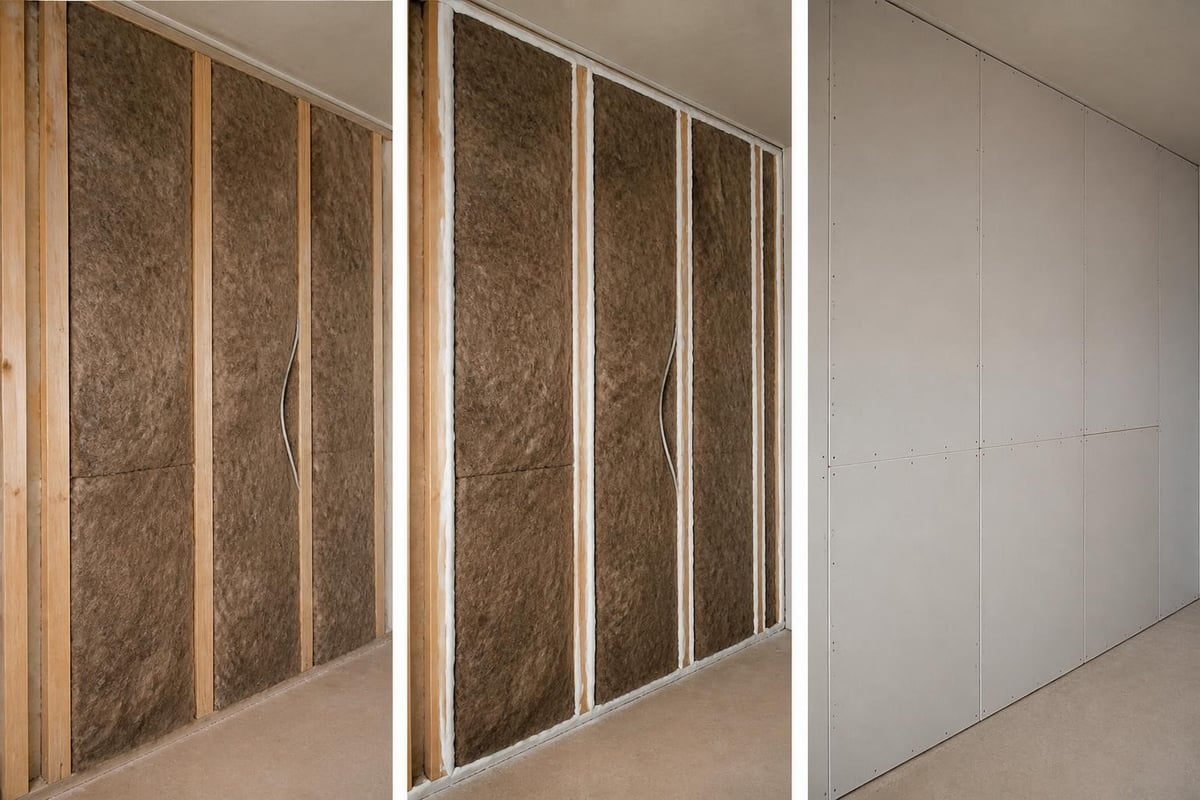
Frame your wall using appropriate construction techniques. Staggered-stud or double-stud frames provide superior acoustic isolation compared to standard single-stud walls.
-
Install acoustic batts by friction-fitting them between studs. Cut batts slightly oversized so they press firmly against the frame without compression. Gaps and compression both reduce acoustic performance.
-
Seal electrical boxes and penetrations using acoustic sealant. The National Research Council study on electrical outlets shows how unsealed boxes significantly compromise sound insulation, reducing wall performance by 5-10 STC points.
-
Apply the first plasterboard layer, ensuring sheets are tightly butted and screwed at appropriate spacing. Stagger vertical joints from the second layer.
-
Add acoustic sealant to all edges, corners, and joints before installing the second plasterboard layer. This flexible sealant remains effective long-term as buildings settle and move.
-
Install the second plasterboard layer with staggered joints, creating a solid continuous barrier. Some builders add a third layer for maximum performance.
-
Seal all perimeter gaps where walls meet floors and ceilings using acoustic sealant. Paint and finishing compounds don't provide adequate acoustic sealing.
Common Installation Mistakes to Avoid
Compressed insulation loses acoustic effectiveness. Batts should fill the cavity completely but not be squashed flat. Maintain their loft for proper sound absorption. Gaps between batts and around edges create sound leaks that dramatically reduce overall wall performance. Even small openings matter.
Electrical outlets and switches on opposite sides of the wall should never align in the same stud cavity. Offset them horizontally by at least 450mm. Better yet, use separate stud frames for each wall face or install acoustic boxes designed to limit sound transmission.
Unsealed penetrations for plumbing, electrical conduits, or ventilation create direct sound paths. Every hole requires acoustic sealing with appropriate materials. Regular expanding foam doesn't provide adequate acoustic performance; use acoustic-rated sealants specifically designed for sound control applications.
Acoustic Performance Standards and Ratings
Understanding acoustic ratings helps you set realistic expectations and compare different sound insulation wall designs. The Sound Transmission Class (STC) rating system provides standardised measurement, though it has limitations worth knowing.
How STC Ratings Work in Practice
STC ratings measure how much sound a wall blocks across specific test frequencies. The rating represents the average reduction in decibels, but doesn't tell the whole story. A wall rated STC 50 reduces sound by 50 decibels at the tested frequencies.
STC 30-34: Normal speech easily understood through the wall. Suitable only where privacy isn't important.
STC 35-39: Loud speech understood, normal speech heard but not clearly intelligible. Minimum standard for bedrooms in most homes.
STC 40-44: Loud speech heard as murmur. Good privacy for most residential applications.
STC 45-49: Loud speech barely audible. Very good privacy and noise control.
STC 50+: Loud sounds heard only faintly. Excellent privacy suitable for home offices, studios, and party walls.
The sound transmission class system provides detailed technical information about how these ratings are calculated and applied in building design.
Limitations of STC Ratings
STC testing focuses on mid-frequency sounds typical of speech. Low-frequency noise from traffic, aircraft, or bass-heavy music isn't adequately represented. A wall might rate STC 50 but still allow noticeable low-frequency rumble.
Field performance often differs from laboratory ratings. Real-world construction includes flanking paths, imperfect sealing, and variations in workmanship. Expect field STC values 5-10 points lower than laboratory ratings unless construction quality is exceptional.
Some noise problems require consideration of impact insulation and vibration control beyond standard airborne sound ratings. Recording studios, home theatres, and apartments above commercial spaces may need specialist acoustic design rather than standard sound insulation wall construction.
Advanced Sound Insulation Wall Techniques
Beyond standard construction, several advanced techniques deliver superior acoustic performance. These methods suit situations requiring maximum noise reduction or dealing with particularly challenging acoustic environments.
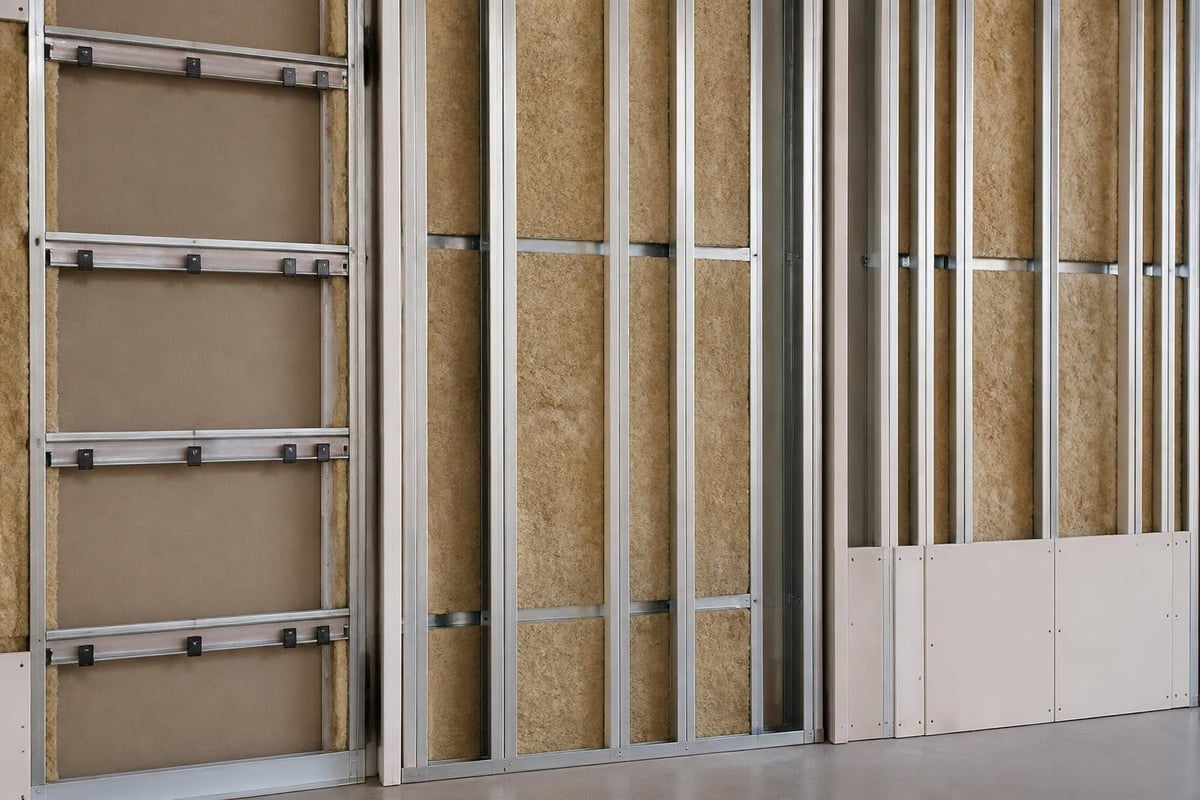
Resilient channels attach horizontally to wall studs before plasterboard installation. The plasterboard screws only into the channels, not directly to studs, creating mechanical isolation. This decoupling reduces vibration transfer and typically improves STC ratings by 5-8 points. Installation requires careful attention to avoid short-circuits where plasterboard touches studs.
Mass-loaded vinyl barriers add significant mass without thickness. These dense rubber-like sheets install between plasterboard layers, adding approximately 5 STC points. Weight makes handling awkward, but results justify the effort in high-performance applications.
Acoustic plasterboard contains increased mass and sometimes viscoelastic polymers that dissipate sound energy. While more expensive than standard plasterboard, a single layer of acoustic board can match the performance of two standard layers in some applications.
Recent research on innovative acoustic metamaterials demonstrates emerging technologies for sound insulation, though most remain in development rather than commercially available for residential construction. Traditional proven methods remain the most cost-effective approach for homeowners in 2026.
Hybrid Thermal and Acoustic Performance
Many homeowners want both thermal efficiency and noise reduction from their walls. Fortunately, these goals complement each other. Acoustic batts provide thermal insulation alongside sound absorption, though thermal-specific products might achieve slightly higher R-values for equivalent thickness.
When designing a sound insulation wall for an external wall, consider combining a permeable wall wrap for moisture management with acoustic batts for sound and thermal control. Products like Drystud Wall Wrap Permeable protect wall cavities from wind and moisture while maintaining breathability, ensuring the building envelope remains dry and healthy alongside acoustic improvements.
Internal walls don't require weather protection but benefit from vapour management in bathrooms and kitchens. Combine appropriate vapour barriers with acoustic insulation for comprehensive wall performance.
Cost Considerations and Budget Planning
Building a sound insulation wall costs more than standard construction but delivers long-term value through improved comfort and amenity. Understanding cost factors helps you budget appropriately and make informed decisions about where to invest.
Material costs vary significantly based on performance requirements. Standard acoustic batts cost approximately $8-12 per square metre, while premium high-density products range from $15-25 per square metre. Plasterboard adds $10-15 per square metre for standard products, with acoustic plasterboard costing $25-35 per square metre.
Labour costs increase with design complexity. Single-stud walls with acoustic batts add minimal labour compared to standard construction. Double-stud or staggered-stud walls require more framing time and materials. Professional acoustic installations for critical applications might cost $150-300 per square metre including materials and labour.
| Wall Type | Material Cost/m² | Labour Complexity | Typical STC | Best For |
|---|---|---|---|---|
| Standard stud + acoustic batt | $20-30 | Standard | 38-42 | Internal bedrooms |
| Double plasterboard + HD batt | $35-50 | Moderate | 45-50 | Home offices, nurseries |
| Staggered-stud + HD batt | $50-70 | Higher | 50-55 | Party walls, studios |
| Double-stud + resilient channels | $80-120 | Specialist | 55-60+ | Maximum performance |
DIY installation reduces costs significantly for capable renovators. Acoustic batts are straightforward to install with basic tools and skills. The primary challenge involves maintaining attention to detail for sealing and avoiding common mistakes. Many installation resources provide guidance for DIY projects.
Where to Prioritise Your Investment
Not every wall requires maximum acoustic treatment. Strategic planning delivers better results for limited budgets. Bedrooms warrant good acoustic treatment for quality sleep, particularly walls facing streets or neighbouring properties. Bedrooms sharing walls with living areas benefit from moderate treatment.
Home offices increasingly require acoustic privacy for video calls and concentration. A sound insulation wall separating the office from active household areas justifies investment for work-from-home professionals.
Party walls in semi-detached or townhouse properties deserve maximum investment. These walls directly affect neighbour relationships and property value. Achieving STC 50+ provides genuine privacy and prevents disputes.
Media rooms and music spaces need isolation to prevent disturbing others. Consider both walls and ceilings in these applications, as sound travels through all surfaces.
Lower priority areas include walls between similar-use spaces (bedroom to bedroom where moderate sound is acceptable) and walls to less-occupied areas like garages or storage rooms.
Retrofitting Acoustic Insulation in Existing Walls
Many homeowners face noise problems in existing homes where walls are already closed in. Retrofitting a sound insulation wall presents challenges but remains possible with appropriate techniques and realistic expectations.
Blown-In Insulation Options
Dense-pack cellulose or glasswool can be blown into existing wall cavities through small access holes. This adds acoustic absorption where none previously existed. The process involves drilling holes near the ceiling, pumping insulation into cavities until full, then patching holes.
Acoustic improvement from blown-in insulation alone remains moderate, typically adding 3-5 STC points. The technique works best combined with adding mass to wall surfaces. Blow-in insulation can't achieve the same performance as properly installed batts during new construction, but provides meaningful improvement without major renovation.
Adding Mass to Existing Walls
The most effective retrofit involves adding mass by installing additional plasterboard layers over existing surfaces. This requires removing and reinstalling skirting boards, door frames, and electrical fittings, but avoids opening walls completely.
Installing a second plasterboard layer with acoustic sealant at all edges typically improves STC by 4-6 points. Using acoustic plasterboard or mass-loaded vinyl between layers increases improvement to 6-10 points. Combined with blown-in cavity insulation, total improvements of 8-12 STC points are achievable.
Resilient channel systems installed over existing plasterboard before adding new layers provide further improvement. The existing wall becomes the first mass layer, resilient channels provide decoupling, and new plasterboard adds additional mass. This three-part system approaches new construction performance without complete wall removal.
Complementary Noise Control Strategies
A sound insulation wall works best as part of a comprehensive approach to noise control. Other elements significantly affect overall acoustic comfort in your home.
Doors create major weak points in otherwise effective acoustic walls. Standard hollow-core doors provide minimal sound blocking. Solid-core doors improve performance, while acoustic-rated doors with proper seals match high-performance wall systems. Door seals around frames are critical, as gaps undermine the entire assembly.
Windows similarly compromise wall performance. Single-glazed windows provide poor sound insulation regardless of wall quality. Double-glazed windows with appropriate air gaps (100-150mm optimal) and different glass thicknesses significantly improve acoustic performance. Laminated acoustic glass provides the best results for street noise.
The sound reduction index explains how different building elements contribute to overall noise control and helps identify weak points in your acoustic strategy.
Ceiling and floor paths allow sound to travel around even excellent walls. Sound travels up through ceilings, across ceiling spaces, and down through adjacent walls. Properly insulating ceiling cavities and sealing ceiling penetrations prevents this flanking path. Floating floors or carpet with underlay reduce impact sound transmission between levels.
Sealing and caulking matters more than most people realise. Small gaps around door frames, skirting boards, electrical outlets, and service penetrations create sound leaks disproportionate to their size. Acoustic sealant applied thoroughly transforms wall performance.
Combining Solutions for Maximum Effect
The most effective acoustic improvements combine multiple strategies. Installing a high-performance sound insulation wall while leaving hollow-core doors and single-glazed windows wastes much of the wall investment. Balance your spending across all noise transmission paths.
For street noise problems, prioritise windows first, then walls, then doors. For neighbour noise through party walls, prioritise the wall construction, then seal every penetration and gap, then address ceiling flanking paths. For internal noise between rooms, good walls and solid doors usually suffice without expensive window treatments.
Consider room layout and furniture as well. Bookshelves, wardrobes, and upholstered furniture against walls add mass and absorption. Thick curtains, carpets, and soft furnishings absorb sound within rooms, reducing the energy trying to escape through walls. These simple measures complement structural improvements cost-effectively.
Building an effective sound insulation wall requires understanding acoustic principles, selecting appropriate materials, and executing careful installation with attention to detail. Whether you're constructing new walls or retrofitting existing ones, combining proper acoustic batts with adequate mass and thorough sealing delivers measurable noise reduction that enhances daily comfort and quality of life. Insulation Supplies Australia offers a comprehensive range of acoustic insulation products backed by expert advice to help you choose the right solution for your noise control needs, with convenient online ordering and fast delivery across Victoria to make your acoustic improvement project straightforward and successful.