

Hard insulation boards have become essential components in modern Australian construction, offering a combination of thermal performance, structural stability and moisture resistance that softer insulation materials simply can't match. Unlike flexible batts or blankets, these rigid panels maintain their shape under compression, making them ideal for applications beneath concrete slabs, around building perimeters and in wall cavities where load-bearing capacity matters. Whether you're building new, renovating or upgrading your home's thermal envelope, understanding the different types of hard insulation boards and their specific applications will help you make smarter choices that deliver lasting comfort and energy savings.
What Are Hard Insulation Boards and Why They Matter
Hard insulation boards are rigid, factory-formed panels designed to provide thermal resistance while maintaining structural integrity under pressure. The term "hard" refers to their firm, unyielding composition, which contrasts sharply with compressible glasswool or polyester batts.
These boards are manufactured from materials including extruded polystyrene (XPS), expanded polystyrene (EPS), polyisocyanurate (polyiso) and mineral wool. Each type offers distinct benefits in thermal conductivity, moisture tolerance and compressive strength.
Core Benefits of Rigid Board Insulation
Why builders and renovators choose hard boards:
- High compressive strength – withstands loads from slabs, pavers and foot traffic without losing R-value
- Consistent thermal performance – rigid structure maintains rated insulation value over decades
- Moisture resistance – closed-cell foams and treated mineral boards repel water and resist vapour transmission
- Easy installation – boards can be scored, cut with a knife or saw, and fitted precisely into tight spaces
- Thermal bridging reduction – continuous exterior insulation wraps the building shell, eliminating cold spots
The ASHRAE Handbook chapter on Heat, Air, and Moisture Control provides technical detail on how rigid boards interact with building assemblies and control heat flow.
Common Types of Hard Insulation Boards in Australia
Not all hard insulation boards are created equal. Material composition determines where and how each type performs best.
Extruded Polystyrene (XPS)
XPS boards are manufactured by forcing polystyrene through a die under heat and pressure, creating a uniform closed-cell structure. The result is a smooth-skinned, high-density panel with exceptional moisture resistance.
Typical applications include:
- Under-slab insulation for suspended and on-ground floors
- Perimeter insulation around foundations and slab edges
- Underfloor systems where moisture exposure is likely
- Cold rooms and cool store construction
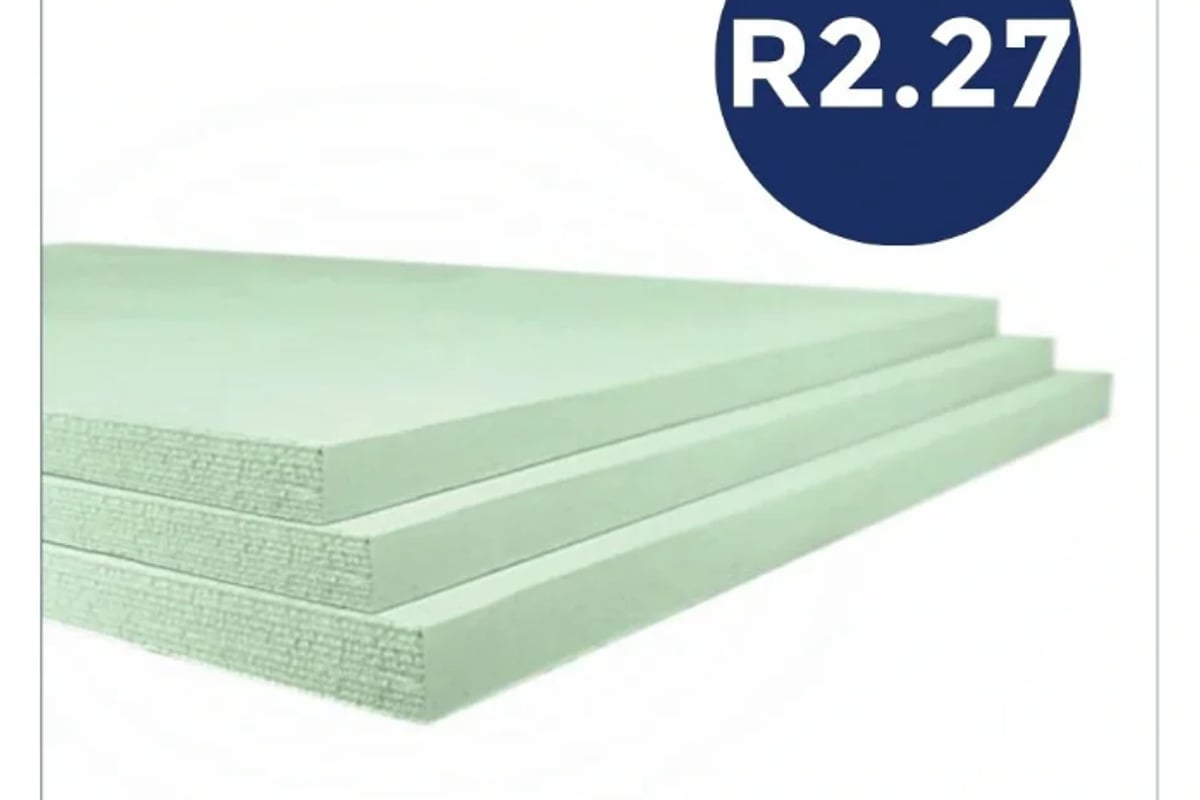
XPS boards typically deliver R-values between R0.5 and R3.0 per 25mm thickness, depending on density and formulation. The Styroboard XPS Insulation Board 75mm x 600mm x 2400mm R2.27 350kPa offers a practical example of high-compressive-strength XPS suited to demanding under-slab applications.
| Feature | XPS Boards |
|---|---|
| Moisture resistance | Excellent (closed-cell) |
| Compressive strength | 150–700 kPa depending on grade |
| Thermal conductivity | ~0.028–0.034 W/m·K |
| Common thickness | 25mm, 50mm, 75mm, 100mm |
| Typical use | Under-slab, underfloor, perimeter |
Expanded Polystyrene (EPS)
EPS is formed by expanding polystyrene beads with steam, then moulding them into blocks that are sliced into boards. The beads fuse together, trapping air pockets within the panel.
EPS is lighter and more cost-effective than XPS but offers slightly lower moisture resistance due to its bead structure. It's widely used in wall cavities, under roofing and around building perimeters where budget and thermal performance must balance.
Where EPS excels:
- External wall insulation systems (rendered facades)
- Under-tile roof insulation
- Retrofit cavity fill in masonry walls
- Lightweight cladding and façade systems
EPS boards are available in various densities, with higher-density options providing better compressive strength and thermal performance.
Polyisocyanurate (Polyiso) Boards
Polyiso boards use a rigid foam core sandwiched between foil or fibre facers. This construction delivers high R-values per millimetre, making polyiso one of the most thermally efficient hard insulation boards available.
Polyiso is commonly used in commercial construction, cool rooms and high-performance residential projects where space is limited but thermal targets are ambitious. The foil facing can also serve as a radiant barrier, reducing heat transfer in roof and wall assemblies.
Mineral Wool Boards
Mineral wool (rock wool or stone wool) boards are made from molten basalt or slag spun into fibres and compressed into rigid panels. Unlike foam boards, mineral wool is non-combustible, vapour-permeable and acoustically effective.
Mineral wool advantages:
- Fire resistance – Class A1 or A2 non-combustible rating
- Sound absorption – ideal for party walls, theatres and studios
- Breathable – allows moisture vapour to pass through, supporting healthy wall assemblies
- Durable – won't sag, settle or degrade with moisture cycling
These boards are often specified in multi-residential, commercial and fire-rated assemblies where safety and acoustic control are paramount. The PHIUS Certification Guidebook references mineral boards in passive-building continuous insulation strategies.
How Hard Insulation Boards Improve Energy Efficiency
Hard insulation boards reduce energy consumption by interrupting heat flow through the building envelope. When installed as continuous insulation (CI), they eliminate thermal bridging caused by timber or steel framing.
Understanding Continuous Insulation
Continuous insulation wraps the entire structure, covering studs, plates and lintels that would otherwise conduct heat. This approach is increasingly mandated in commercial and high-performance residential construction.
By placing rigid boards on the exterior (or occasionally interior) side of framing, you achieve:
- Uninterrupted thermal resistance across the whole façade
- Reduced condensation risk by keeping structural elements warm
- Higher effective R-values compared to cavity-only insulation
- Better airtightness when boards are taped or sealed at joints
The ASHRAE Standard 90.1 energy-efficiency requirements increasingly call for continuous rigid insulation in commercial assemblies, a trend that's influencing Australian practice.
Thermal Performance Comparison
| Material | Approx. R-Value per 25mm | Best Use |
|---|---|---|
| XPS | R0.7–R1.0 | Under-slab, wet areas |
| EPS | R0.6–R0.8 | Walls, roofs, general CI |
| Polyiso | R1.0–R1.3 | High-efficiency projects, space-limited areas |
| Mineral wool | R0.6–R0.8 | Fire-rated, acoustic, breathable assemblies |
Where to Install Hard Insulation Boards
The versatility of rigid boards means they can be deployed in almost any part of the building envelope. Here's where they deliver the best results.
Under-Slab and Underfloor Applications
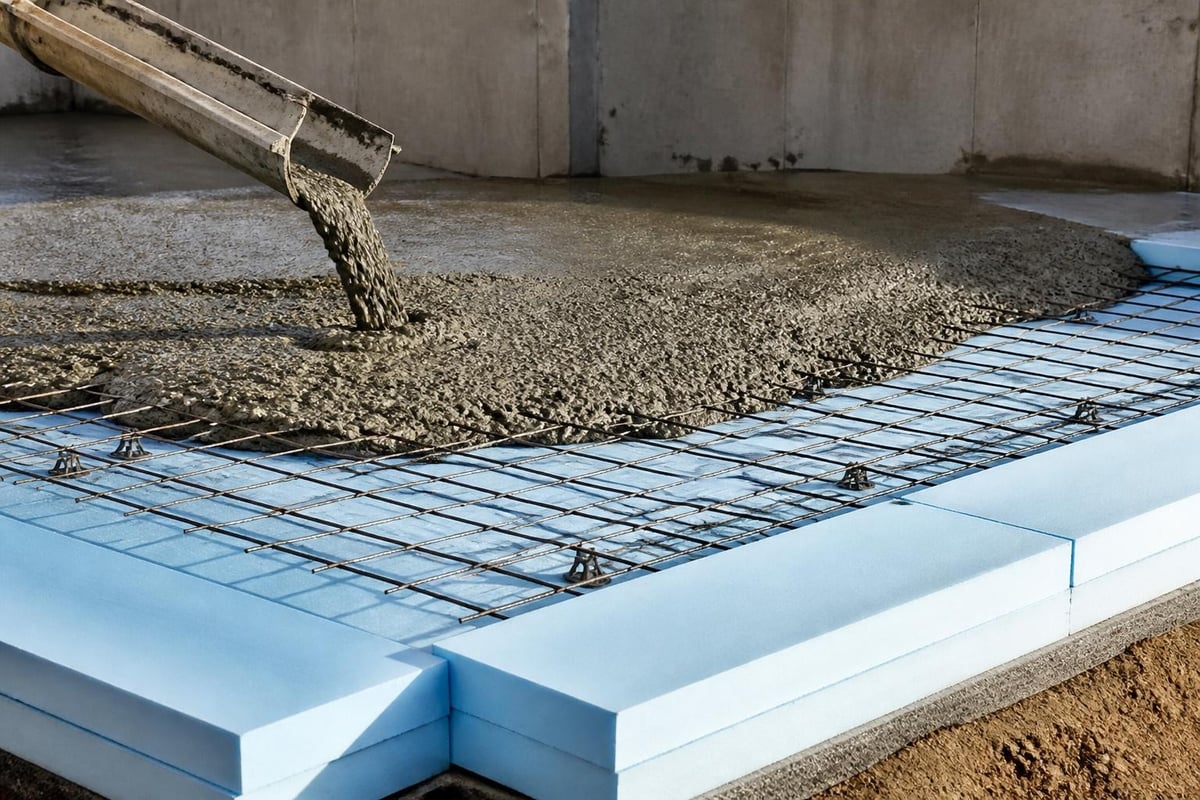
Installing hard boards beneath concrete slabs prevents ground heat loss and creates a stable, comfortable floor temperature. XPS is the go-to choice here due to its high compressive strength and moisture impermeability.
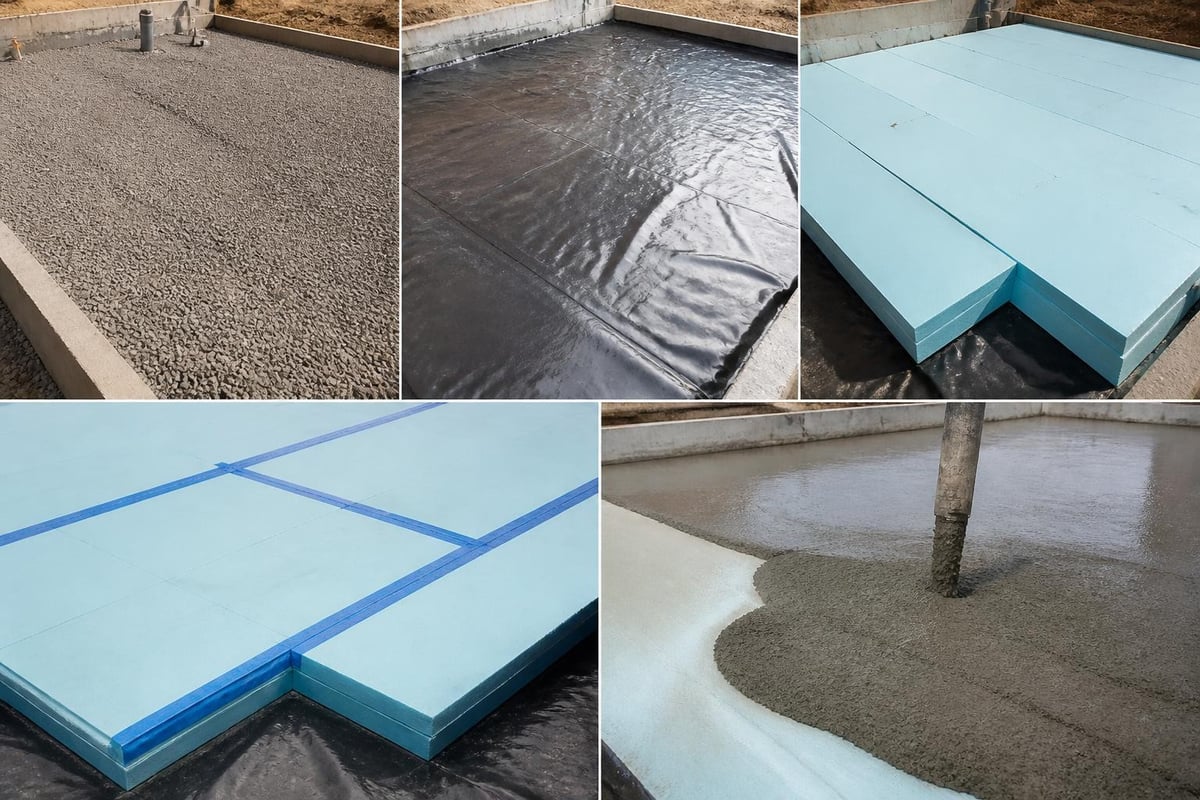
Steps for under-slab installation:
- Prepare a clean, level substrate (compacted sand or crusher dust)
- Lay a damp-proof membrane (polyethylene sheet)
- Position XPS boards edge-to-edge with staggered joints
- Tape or seal joints to prevent concrete intrusion
- Pour concrete slab directly over the boards
For suspended timber floors, boards can be fixed to the underside of joists or laid within the floor cavity. Combining rigid boards with reflective foil wraps maximises thermal and draught control. Explore underfloor insulation options for more guidance on this application.
External Wall Insulation (Continuous Insulation)
Rigid boards mounted on the outside of timber or steel framing create a continuous thermal barrier. This approach is particularly effective in retrofit projects where internal wall cavities are inaccessible.
Installation sequence:
- Fix framing and sheathing as per structural design
- Secure rigid boards to the exterior face using adhesive and mechanical fasteners
- Stagger joints and ensure tight fit to minimise gaps
- Tape all board seams with compatible tape to maintain airtightness
- Install cladding or render system over the boards
EPS and mineral wool boards are commonly used here, with mineral wool preferred where fire ratings and breathability are critical. The BRE guidance manual offers practical advice on identifying and retrofitting external rigid insulation in UK contexts, with many principles applicable to Australian projects.
Roofing and Sarking Applications
Hard boards installed above roof decking but beneath the roofing membrane provide thermal resistance and moisture control. Polyiso boards with foil facings are popular in commercial metal roof systems, while EPS and mineral wool suit residential tile and metal roofs.
For residential projects, many builders pair rigid boards with traditional roof insulation batts or blankets to achieve higher R-values cost-effectively.
Perimeter and Edge Insulation
Slab edges and foundation perimeters lose significant heat if left uninsulated. Hard boards installed vertically around the slab edge reduce thermal bridging and improve whole-building performance.
This detail is especially important in passive house and high-performance builds, where every watt of heat loss counts.
Installation Tips for Hard Insulation Boards
Proper installation ensures hard insulation boards perform as intended. Here's what every installer should know.
Cutting and Handling
Most foam boards can be scored and snapped with a utility knife, while mineral wool boards require a handsaw or circular saw. Always wear appropriate PPE: dust masks for mineral wool, eye protection for all cutting operations.
When cutting boards:
- Measure twice, cut once
- Use a straight edge or T-square for accuracy
- Support the board to prevent flexing during cuts
- Minimise off-cuts by planning your layout in advance
Sealing Joints and Penetrations
Air leakage through board joints undermines thermal performance and can cause condensation issues. Sealing is non-negotiable.
Best practices:
- Use compatible tape designed for your board type (foil tape for foil-faced boards, acrylic tape for EPS/XPS)
- Apply tape with firm pressure to ensure adhesion
- Seal around all penetrations (pipes, cables, vents) with expanding foam or sealant
- Overlap tape by at least 50mm at corners and intersections
The EPA Indoor AirPlus guidance highlights the importance of controlling air leakage and selecting low-VOC materials to maintain healthy indoor environments.
Fastening Methods
Mechanical fastening requirements vary by application and board type. Under-slab boards typically need no fasteners, while wall and roof boards require screws, nails or adhesive.
| Application | Fastening Method |
|---|---|
| Under-slab | None (held by slab weight) |
| External wall CI | Adhesive + plastic-cap screws |
| Roof sarking | Screws or nails through to rafters |
| Cavity fill | Friction fit or adhesive dabs |
Always follow manufacturer guidelines and local building codes for fastener spacing and type.
Managing Moisture and Condensation
Hard boards with low vapour permeance (XPS, polyiso) can trap moisture if installed incorrectly. In Australian climates, positioning the vapour control layer on the warm side of the assembly is essential.
Rules of thumb:
- In heating-dominated climates (southern Australia), place vapour barriers toward the interior
- In cooling-dominated climates (northern Australia), avoid impermeable layers on the interior unless air-conditioned year-round
- Use breathable boards (mineral wool, vapour-permeable EPS) where moisture transport is critical
- Ensure proper drainage and ventilation behind cladding systems
For more on wall assembly design, see wall insulation collections and product recommendations.
Comparing Hard Insulation Boards to Other Insulation Types
Hard boards aren't always the right choice. Here's how they stack up against flexible batts, reflective foil and spray foam.
Hard Boards vs. Glasswool Batts
| Feature | Hard Boards | Glasswool Batts |
|---|---|---|
| Compressive strength | High (50–700 kPa) | Nil (compressible) |
| Moisture resistance | Excellent (foam), Good (mineral wool) | Poor (absorbs water) |
| Thermal bridging control | Excellent (continuous CI) | Moderate (cavity only) |
| Cost per m² | Higher | Lower |
| Installation speed | Fast (large panels) | Moderate (batts per cavity) |
| Best use | Under-slab, external CI, perimeter | Stud walls, ceilings, roofs |
Batts like Earthwool Blanket Unfaced R3.2 excel in standard cavity applications, while hard boards dominate where compression resistance and moisture control matter most.
Hard Boards vs. Reflective Foil
Reflective foil works by reflecting radiant heat, not resisting conductive heat flow. Foil systems need an air gap to function and provide minimal benefit when compressed or fully adhered.
Hard boards provide conductive resistance (R-value) regardless of air gaps, making them more versatile and predictable in performance. Many builders combine both: rigid boards for bulk insulation, foil for radiant barriers in roofs and underfloor spaces.
Hard Boards vs. Spray Foam
Spray polyurethane foam (SPF) offers high R-value per inch and seamless coverage, but it's expensive, requires specialist equipment and can't be DIY-installed.
Hard boards are more economical, easier to handle and suitable for both professional and DIY projects. For homeowners and small renovators, boards offer a practical balance of performance, cost and installation simplicity.
Sustainability and Environmental Considerations
Hard insulation boards vary widely in their environmental footprint, from petrochemical foams to natural mineral products.
Embodied Energy and Carbon
EPS and XPS boards are petroleum-based, with moderate to high embodied energy. However, their long service life and energy savings over decades often offset the upfront carbon cost.
Polyiso boards generally have lower global warming potential (GWP) than XPS, as they use blowing agents with reduced ozone depletion and climate impact.
Mineral wool boards are made from abundant natural materials (basalt, recycled slag) and have lower embodied carbon than foam products. They're also non-combustible and fully recyclable at end of life.
Indoor Air Quality and VOCs
Foam boards can off-gas volatile organic compounds (VOCs) during and after installation, though emissions typically decline rapidly. Selecting products with low-VOC certifications and ensuring adequate ventilation during installation minimises health risks.
Mineral wool boards emit negligible VOCs and support healthier indoor air quality. The Energy Star guidance on rigid insulation includes tips for selecting low-impact products.
Recyclability and Disposal
Most foam boards are not readily recycled in Australia, though specialist facilities can process clean off-cuts. Mineral wool boards can be reprocessed or repurposed, making them a more circular choice.
Planning careful layouts to minimise waste and storing off-cuts for small projects reduces landfill impact.
Cost Considerations and Budgeting
Hard insulation boards cost more per square metre than batts but often deliver better long-term value in the right applications.
Factors affecting cost:
- Material type (EPS cheapest, polyiso most expensive)
- Thickness and R-value
- Compressive strength grade
- Facer type (plain, foil, fibre-reinforced)
- Quantity and delivery charges
For budget-conscious renovators, EPS boards offer a solid balance of thermal performance and affordability, while XPS justifies its premium in wet or high-load applications.
When comparing quotes, always calculate the total installed cost (material + labour + fasteners + sealants) rather than material price alone.
Selecting the Right Hard Insulation Board for Your Project
Choosing the right board starts with understanding your project's specific needs: thermal targets, moisture exposure, structural loads and fire ratings.
Decision Framework
Ask yourself:
- What R-value do I need to meet? (Check NCC climate zone requirements for your location)
- Will the board be exposed to moisture? (If yes, prioritise XPS or closed-cell foam)
- Does it need to carry a load? (Under-slab and trafficable areas need high compressive strength)
- Are there fire or acoustic requirements? (Mineral wool boards offer best fire and sound performance)
- What's my budget per m²? (Balance upfront cost with long-term energy savings)
Practical Examples
| Project Type | Recommended Board | Why |
|---|---|---|
| New slab-on-ground home | XPS 50–100mm, 250–350 kPa | Moisture resistance, high compressive strength |
| External wall retrofit | EPS 50–75mm or mineral wool | Cost-effective CI, easy to clad |
| Passive house build | Polyiso or high-density mineral wool | High R/mm, thermal bridging control |
| Party wall acoustic | Mineral wool board 50–100mm | Fire rating, sound absorption |
| Underfloor suspended timber | XPS 50–75mm | Moisture resistance, easy installation |
For detailed product specifications and R-value options, browse the under-slab insulation collection to find boards matched to your application.
Common Mistakes to Avoid
Even experienced builders can trip up when working with hard insulation boards. Here's what to watch out for.
Ignoring Vapour Control
Installing impermeable boards without considering vapour drive can trap moisture and cause mould, rot or structural damage. Always design the assembly to allow vapour to escape or prevent it from entering in the first place.
Leaving Gaps and Unsealed Joints
Air leakage through board joints wastes energy and creates cold spots. Take the time to tape every seam and seal every penetration.
Over-Compressing Boards
While hard boards resist compression better than batts, excessive force (from fasteners, cladding or slab loads) can still reduce R-value. Use spacers, adhesive dabs or rated fasteners to avoid crushing the insulation.
Mixing Incompatible Materials
Not all tapes, adhesives and facers are compatible with all board types. Always check manufacturer datasheets and use recommended accessories.
Skipping Manufacturer Instructions
Each product has specific installation requirements, from fastener spacing to maximum height limitations. Ignoring these can void warranties and compromise performance.
Regulatory and Code Compliance
Hard insulation boards must meet Australian building standards and relevant product certifications.
NCC Requirements
The National Construction Code (NCC) sets minimum R-values for different climate zones and building elements. Hard boards can help you meet or exceed these requirements, particularly in challenging details like slab edges and continuous insulation.
Fire Performance
Foam boards typically have combustibility ratings between Group 2 and Group 3. Where fire resistance is mandated (e.g., multi-residential, bushfire-prone areas), mineral wool boards or fire-rated foam products are essential.
Product Standards
Look for boards compliant with Australian Standards (AS/NZS 4859 series) and, where applicable, international standards like BS EN 13165 for rigid PU/PIR boards.
Certified products carry third-party testing and consistent performance data, giving you confidence in the declared R-values and compressive strengths.
Hard insulation boards offer unmatched versatility, structural stability and thermal performance for Australian homes and commercial projects. From under-slab foundations to external continuous insulation, choosing the right board type and installing it correctly ensures decades of comfort, energy savings and moisture protection. Whether you're tackling a DIY renovation or managing a large build, Insulation Supplies Australia stocks a comprehensive range of rigid insulation boards, underfloor wraps and complementary products to meet every project need. Browse our collections online, compare R-values and specifications, and get your insulation delivered across Victoria.