

Choosing the best underfloor insulation for your home can dramatically improve comfort and slash heating bills, especially during Melbourne's chilly winter months. Suspended timber floors are notorious for letting cold air seep through from below, making rooms feel icy even when the heater is running. The right underfloor insulation creates a thermal barrier that keeps warmth inside while blocking draughts, reducing energy consumption and creating a more comfortable living environment year-round.
Why Underfloor Insulation Matters for Australian Homes
Many older Australian homes were built with elevated timber floors and minimal or no insulation beneath them. This design allows cold air to circulate freely under the house, making floors uncomfortably cold and forcing heating systems to work harder.
Installing quality underfloor insulation addresses several common problems:
- Reduces heat loss through the floor, which can account for 10-20% of total home heat loss
- Eliminates cold draughts that make rooms feel chilly even with heating on
- Lowers energy bills by reducing the workload on heating and cooling systems
- Improves acoustic performance by dampening sound transmission between floors
- Increases overall home comfort by maintaining more consistent indoor temperatures
The Building Research Establishment has extensively researched floor insulation performance and consistently found that properly installed underfloor insulation delivers measurable improvements in thermal comfort and energy efficiency.
Understanding R-Values for Underfloor Applications
R-value measures thermal resistance, indicating how effectively insulation resists heat flow. Higher R-values provide better insulation performance.
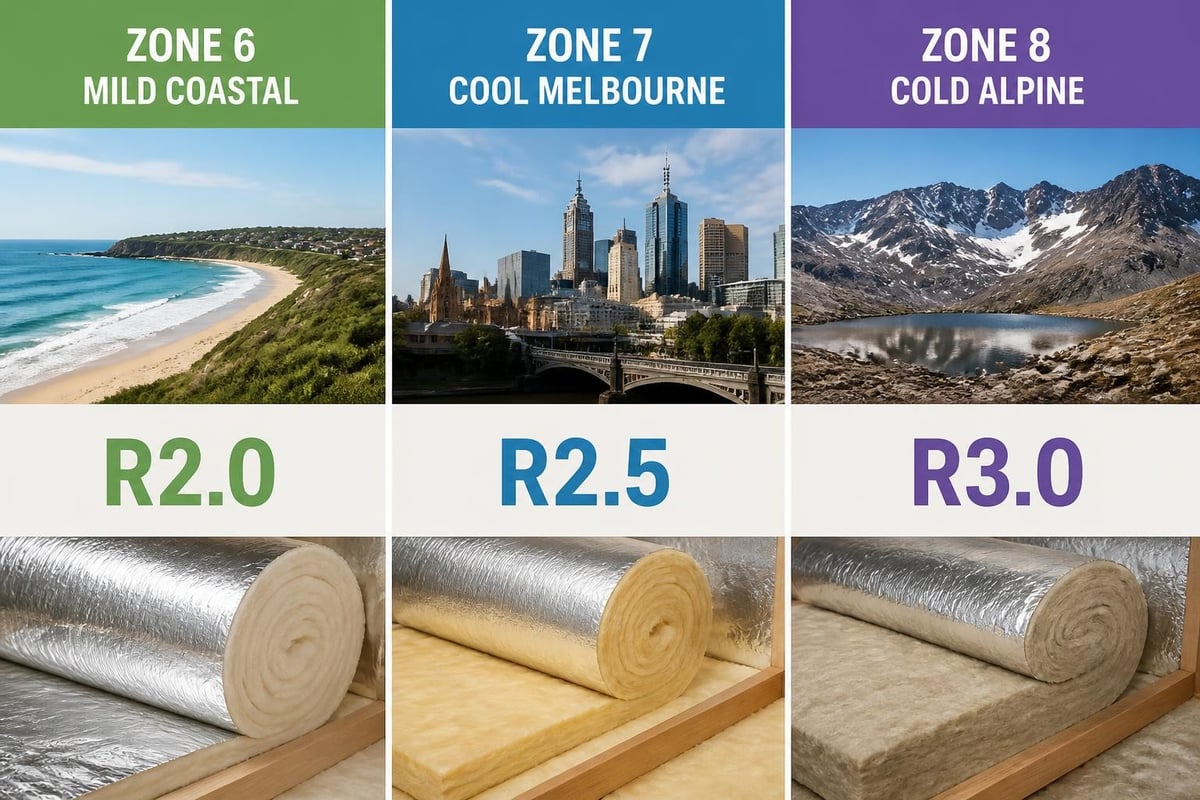
For underfloor applications in Australian homes, recommended R-values typically range from R1.0 to R2.5 depending on your climate zone and floor construction. Melbourne and most Victorian regions benefit from R2.0 to R2.5 underfloor insulation.
Climate Zone Recommendations
| Climate Zone | Location Examples | Minimum R-Value | Recommended R-Value |
|---|---|---|---|
| Zone 6 (Mild) | Coastal Victoria, Sydney | R1.5 | R2.0 |
| Zone 7 (Cool) | Melbourne, Canberra | R2.0 | R2.5 |
| Zone 8 (Cold) | Alpine regions, Ballarat | R2.5 | R3.0+ |
The National Construction Code (NCC) sets minimum standards, but exceeding these minimums often delivers better long-term value through greater energy savings and comfort improvements.
Types of Underfloor Insulation Materials
Several material options suit underfloor applications, each with distinct characteristics, benefits and installation requirements.
Glasswool Batts
Glasswool batts specifically designed for underfloor use offer excellent thermal performance and remain the most popular choice for suspended timber floors. These batts fit between floor joists and are held in place with support systems.
Key advantages:
- High thermal resistance per dollar spent
- Non-combustible and fire-resistant
- Excellent acoustic dampening properties
- Soft texture makes handling easier
- Proven long-term performance
Considerations:
- Requires proper support system (mesh, wire or strapping)
- Must stay dry to maintain performance
- Protective equipment recommended during installation
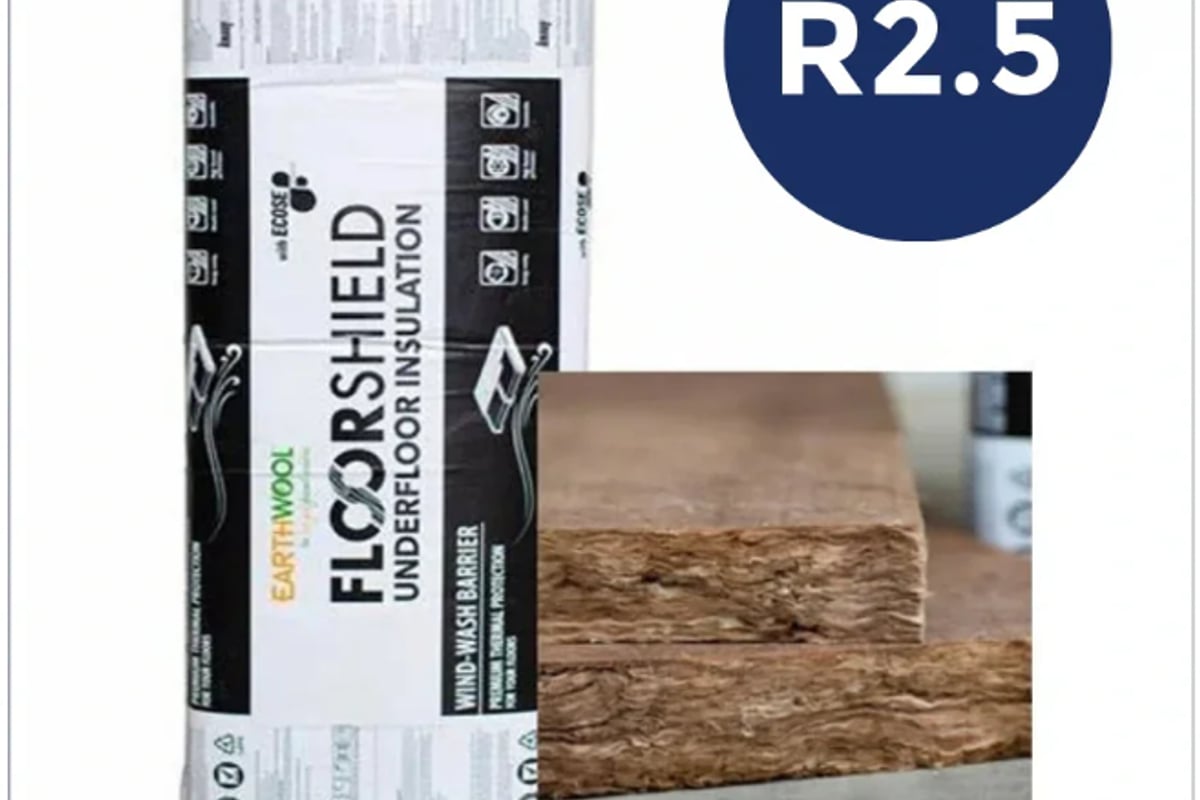
The Floorshield R2.5 Underfloor Batts 90mm x 420mm x 1160mm are purpose-built for suspended floors, manufactured with ECOSE Technology for low dust and easy handling. These batts deliver solid R2.5 thermal performance while remaining soft to touch and simple to install between standard joist spacings.
Reflective Foil Insulation
Reflective foil products work differently from bulk insulation. They reflect radiant heat and create a vapour barrier that blocks moisture and draughts.
Performance characteristics:
- Lightweight and quick to install
- Excellent moisture barrier properties
- Reflects radiant heat back into living spaces
- Doubles as draught seal beneath floors
- Lower thermal resistance compared to bulk insulation
Reflective foil works best when combined with an air gap. Installation involves draping the foil across the underside of floor joists and stapling it in place, creating a sealed barrier.
Rigid Board Insulation
Extruded polystyrene (XPS) and polyisocyanurate boards provide high R-values in thinner profiles and excel in moisture-prone areas.
Benefits include:
- High compressive strength
- Excellent moisture resistance
- Stable R-value over time
- Suitable for ground contact applications
- Minimal thickness for restricted spaces
Rigid boards cost more per square metre but work well in specific situations like insulating concrete slabs or areas with limited clearance. The Building America Solution Center provides detailed technical guidance on using rigid board insulation for slab and perimeter applications.
Selecting the Best Underfloor Insulation for Your Project
Choosing the right product depends on multiple factors including floor construction, climate, budget, moisture exposure and installation method.
Decision Framework
| Factor | Best Choice | Alternative |
|---|---|---|
| Standard timber floor, dry area | Glasswool batts R2.5 | Reflective foil + batts |
| Moisture-prone underfloor area | Reflective foil barrier | Closed-cell rigid board |
| Budget-conscious project | R2.0 glasswool batts | Reflective foil only |
| Maximum thermal performance | R2.5-R3.0 batts | High-density batts |
| DIY installation priority | Reflective foil | Pre-cut batts |
| Heritage home with restricted access | Rigid board sections | Thin reflective products |
For most Melbourne homes with suspended timber floors, glasswool batts rated R2.5 represent the best underfloor insulation choice. They balance cost, performance, availability and ease of installation while delivering measurable improvements in comfort and energy efficiency.
Material Comparison Table
| Material Type | R-Value Range | Cost Range | Moisture Resistance | DIY Friendly | Lifespan |
|---|---|---|---|---|---|
| Glasswool batts | R1.5-R3.0 | $$ | Moderate | Yes | 50+ years |
| Reflective foil | R0.5-R1.0 | $ | Excellent | Very easy | 50+ years |
| XPS rigid board | R1.0-R2.5 | $$$ | Excellent | Moderate | 50+ years |
| Polyester batts | R1.5-R2.5 | $$ | Good | Yes | 50+ years |
Installation Methods and Best Practices
Proper installation is critical for achieving rated thermal performance and preventing issues like sagging, gaps or moisture problems.
Glasswool Batt Installation
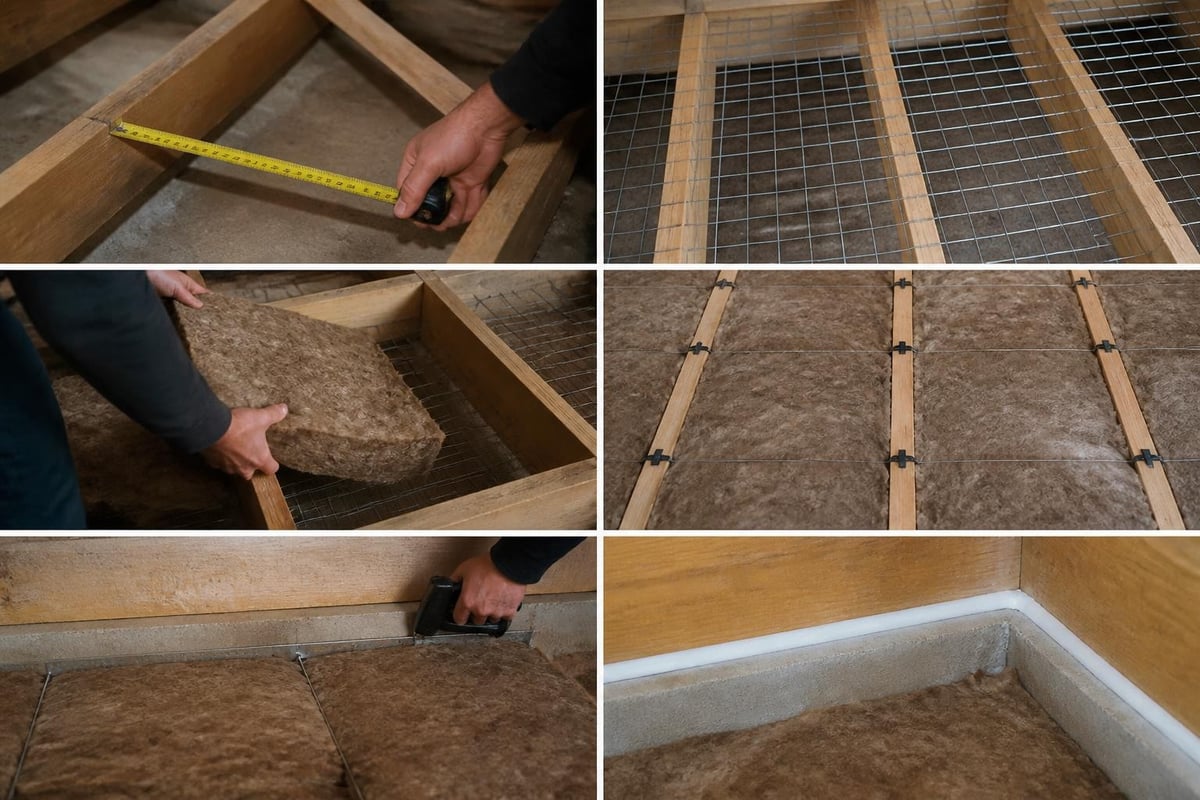
Installing batts beneath suspended floors requires access to the underfloor area and appropriate support systems:
- Measure joist spacing accurately to order correctly sized batts
- Prepare the underfloor area by removing debris and checking for moisture issues
- Install support systems such as galvanised wire mesh, nylon strapping or plastic support clips
- Fit batts snugly between joists, ensuring full contact without compression
- Secure properly to prevent sagging or falling over time
- Seal gaps around pipes, vents and perimeter edges
Batts should fit tightly against the underside of floorboards with no gaps. Compression reduces R-value, so choose the correct thickness for your joist depth.
Reflective Foil Installation
Foil installation is generally faster and requires less specialised support:
- Clean floor joists to ensure good staple adhesion
- Unroll foil across the underside of joists perpendicular to joist direction
- Staple every 150-200mm along each joist
- Overlap joins by at least 100mm and tape with foil tape
- Seal perimeter edges against subfloor or foundation walls
- Maintain air gap above foil surface (at least 25mm) for reflective properties
The Building Research Establishment research emphasises proper air gaps and sealed joints for reflective insulation to perform as rated.
Common Installation Mistakes to Avoid
Compressed insulation: Squashing batts into spaces reduces their R-value significantly. Always use the correct thickness.
Gaps and voids: Even small gaps allow heat to escape and cold air to enter. Careful fitting around obstacles is essential.
Inadequate support: Batts that sag or fall create uninsulated areas. Proper wire mesh or strapping support prevents this problem.
Moisture exposure: Insulation in damp conditions loses effectiveness and may develop mould. Address drainage and ventilation issues before installing.
Missing vapour barriers: In moisture-prone areas, combining batts with a reflective foil vapour barrier protects insulation and floor structure.
Moisture Management and Ventilation Considerations
Underfloor areas in Australian homes often experience moisture issues, especially in coastal regions or properties with poor drainage. Managing moisture is crucial for insulation longevity and performance.
Key moisture control strategies include:
- Improving site drainage to direct water away from foundations
- Installing vapour barriers on exposed ground beneath the house
- Maintaining adequate ventilation through properly sized vents
- Addressing plumbing leaks promptly
- Using moisture-resistant materials in high-risk areas
The ASHRAE Handbook guidance on building envelopes provides detailed technical information on hygrothermal performance and moisture control in floor assemblies.
For homes with persistent moisture concerns, combining a ground vapour barrier with reflective foil underfloor insulation creates a robust moisture management system while still improving thermal performance.
Cost Considerations and Return on Investment
Underfloor insulation represents a significant investment that pays dividends through reduced energy bills and improved comfort.
Typical Cost Breakdown
Materials (per square metre):
- Glasswool batts R2.5: $8-12
- Reflective foil: $4-7
- Rigid board XPS: $15-25
- Support materials (mesh, strapping): $2-4
Professional installation (per square metre):
- Standard suspended floor: $30-50
- Difficult access areas: $50-80
- Includes materials and labour
DIY costs (materials only):
- Average 100m² underfloor area: $1,000-1,500
- Support materials and accessories: $200-400
- Tools and safety equipment: $100-200
The U.S. Department of Energy research on home improvement shows that floor insulation typically delivers payback periods of 5-8 years through energy savings, though Australian conditions and energy prices produce different results.
Energy Savings Estimates
For a typical Melbourne home with 100m² of suspended floor:
- Annual heating cost before insulation: $800-1,200
- Estimated reduction with R2.5 insulation: 15-25%
- Annual savings: $120-300
- Payback period (DIY): 5-7 years
- Payback period (professional install): 10-15 years
These figures vary based on existing floor construction, heating systems, occupancy patterns and energy prices. Homes in colder regions or with electric heating see greater savings.
Combining Underfloor Insulation with Other Upgrades
Maximum home performance comes from a whole-house approach to thermal efficiency. Underfloor insulation works best when combined with complementary upgrades.
Effective combinations include:
Ceiling insulation: Heat rises, so insulating ceilings prevents the biggest source of heat loss. Combined ceiling and floor insulation creates a thermal envelope.
Wall insulation: Completing the building envelope by insulating walls delivers comprehensive thermal performance improvements.
Draught sealing: Sealing gaps around doors, windows, vents and penetrations prevents air leakage that undermines insulation effectiveness.
Window treatments: Heavy curtains, cellular blinds or double glazing reduce heat loss through windows, which can be the weakest thermal points.
Insulation Supplies Australia stocks a comprehensive range of insulation products for every application, making it easy to tackle multiple thermal upgrades in one project.
Best Underfloor Insulation for Different Home Types
Different building styles and construction methods suit different insulation approaches.
Weatherboard Homes
Classic weatherboard homes typically have good underfloor access and standard joist spacing. R2.5 glasswool batts work perfectly for these properties, fitting easily between 400-450mm joist centres with wire mesh or plastic clip support.
Brick Veneer Construction
Brick veneer homes often have suspended timber floors with similar access. The same batt systems work well, though ensuring proper ventilation becomes more important due to the brick exterior retaining moisture.
Heritage and Period Homes
Older homes may have irregular joist spacing, limited access or heritage considerations. Reflective foil insulation or rigid board sections offer easier installation in restricted spaces. Bath & North East Somerset Council guidance provides valuable insights on sensitively insulating heritage properties.
Modern Slab-on-Ground Construction
Concrete slab homes require different approaches. Rigid insulation boards installed beneath the slab during construction or perimeter insulation reduces heat loss through the slab. CodeHub technical guidance details slab insulation requirements and methods.
Installation Timeframes and DIY vs Professional
Understanding installation requirements helps determine whether to DIY or hire professionals.
DIY Installation
Suitable for:
- Homeowners with good underfloor access
- Standard joist spacing and construction
- Moderate-sized areas (under 100m²)
- Dry underfloor conditions
- Those comfortable working in confined spaces
Time requirements:
- 100m² area with good access: 2-3 days
- Including preparation and cleanup: 3-4 days
- Learning curve adds 20-30% for first-timers
Professional Installation
Recommended for:
- Limited or difficult underfloor access
- Large areas (over 150m²)
- Moisture problems requiring remediation
- Complex floor constructions
- Those preferring guaranteed results
Professional installers complete the job faster and guarantee workmanship, but costs increase significantly. For straightforward applications, DIY installation saves money while delivering equivalent thermal performance if done carefully.
Product Selection Checklist
Use this checklist when selecting the best underfloor insulation for your specific situation:
- Measured joist spacing accurately
- Determined required R-value for climate zone
- Assessed underfloor moisture conditions
- Checked accessibility for installation
- Calculated total area requiring insulation
- Decided on DIY or professional installation
- Budgeted for materials and support systems
- Considered combining with other thermal upgrades
- Reviewed moisture management requirements
- Planned for proper ventilation maintenance
Working through this checklist ensures you consider all relevant factors before purchasing materials and starting installation.
Regulatory Requirements and Building Codes
Australian building regulations set minimum insulation standards for new construction and renovations.
The National Construction Code (NCC) specifies thermal performance requirements through various pathways. For underfloor insulation in climate zone 7 (Melbourne and surrounds), meeting elemental provisions typically requires R2.0 to R2.5 depending on floor construction details.
When undertaking significant renovations, building permits may require compliance with current thermal standards. Always check with your local council regarding permit requirements for insulation upgrades.
The ABCB website provides current NCC requirements and compliance pathways for residential buildings, including insulation specifications for different climate zones.
Maintaining Underfloor Insulation Long-Term
Quality insulation lasts 50+ years with minimal maintenance, but periodic checks ensure ongoing performance.
Recommended maintenance includes:
Annual inspections of underfloor areas for moisture, pests or damage Checking support systems for sagging or detached sections Verifying ventilation remains adequate and vents are unblocked Addressing moisture issues promptly before insulation degrades Repairing damage from renovations or service work quickly
Well-installed glasswool and reflective foil insulation require virtually no maintenance beyond these basic checks. Moisture is the primary enemy, so managing drainage and ventilation protects your investment.
Environmental Considerations and Sustainability
Modern insulation products increasingly incorporate sustainable manufacturing practices and recycled content.
Glasswool insulation manufactured with ECOSE Technology uses bio-based binders rather than traditional formaldehyde-based options, reducing emissions and improving indoor air quality. Many products contain significant recycled glass content.
From a whole-house perspective, the best underfloor insulation delivers environmental benefits through reduced energy consumption. Heating and cooling typically account for 40% of residential energy use, so effective insulation substantially lowers carbon emissions over the building's lifetime.
Selecting the best underfloor insulation requires balancing R-value requirements, material properties, installation methods and budget constraints for your specific situation. Most Melbourne homes with suspended timber floors benefit most from R2.5 glasswool batts combined with proper moisture management and adequate ventilation. Whether you're tackling a DIY weekend project or planning a comprehensive thermal upgrade, Insulation Supplies Australia offers expert advice, quality products and competitive prices to help you create a warmer, more energy-efficient home with confidence.